2 November 2026 · Daivagya
Vivah Panchami 2026 (23 November): Why Some Families Avoid It and What Jyotish Actually Says
Understand the cultural lore, planetary facts, and classical Jyotish rules surrounding Vivah Panchami 2026 before fixing your wedding date.
Quick answer
Vivah Panchami marks the sacred union of Shri Rama and Mata Sita, yet many families avoid solemnising weddings on this day due to cultural folklore surrounding their later trials. Classical Jyotish does not treat Vivah Panchami as a universal ban or an automatic green light; instead, it requires rigorous Panchanga Shuddhi, Tribala verification, and individual horoscope alignment before fixing any wedding ceremony.
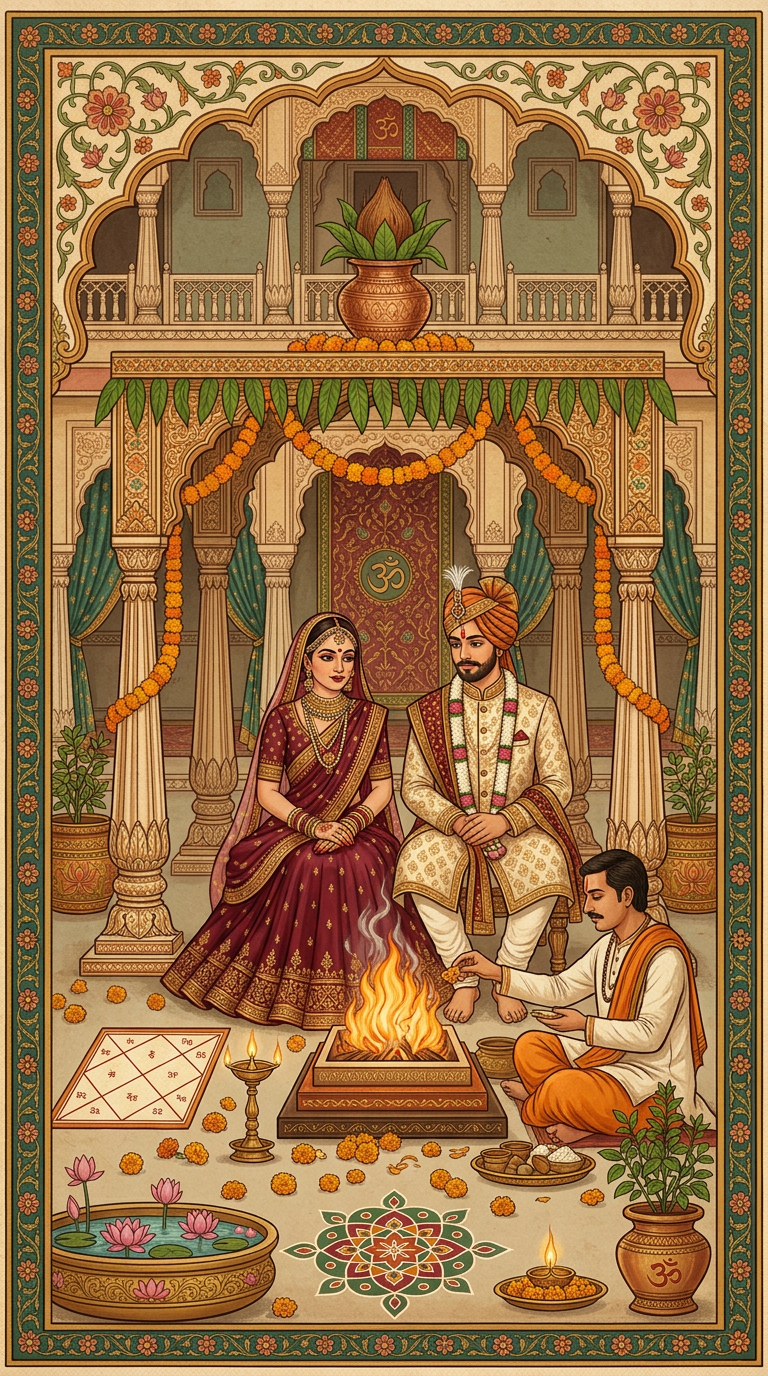
Every year, as the winter wedding season gathers pace across North India, families walk into my Noida consultation room holding panchang calendars and looking anxious. Few topics generate as much confusion between generations as Vivah Panchami. On paper, it marks one of the most revered milestones in our sacred history: the divine wedding of Bhagwan Shri Rama and Mata Sita in Janakpur. Yet, when young couples suggest this sacred date for their own wedding, grandparents frequently object with deep unease.
On Monday, 23 November 2026, the sacred tithi of Vivah Panchami 2026 will be observed across temples worldwide. If you and your family are currently planning a wedding for late 2026, you may already be hearing contrasting opinions. Some view it as an inherently blessed festival, while others warn that human marriages conducted on this day invite hardship and sorrow.
In my practice at Daivagya, I believe in replacing anxiety with clear scriptural understanding. Let us examine what the classical texts of Muhurat Shastra actually state, why cultural folklore developed around this date, and how you should approach this day from an astrological perspective.
What is Vivah Panchami and why is 23 November 2026 significant?
Vivah Panchami falls on the Shukla Paksha Panchami (fifth waxing lunar day) of the Margashirsha month according to the traditional Hindu lunar calendar (or Agrahayana in some regional traditions). In 2026, this auspicious lunar day begins on the evening of 22 November and spans across the daylight hours of 23 November, making Monday, 23 November 2026 the primary day of festival observance.
According to Valmiki Ramayana and the Ramcharitmanas of Goswami Tulsidas, King Janaka organised the historic Sita Swayamwar on this sacred tithi. When Shri Rama effortlessly strung the mighty Pinaka bow of Lord Shiva, Mata Sita placed the Jayamala around his neck, uniting two great royal lineages and bringing divine grace to the world.
Across Mithila, Ayodhya, and temple towns across India and Nepal, Margashirsha Shukla Panchami is celebrated with immense joy. Deities are adorned in bridal finery, grand processions (Barat) are staged, and sacred wedding hymns are chanted in temples from dawn to midnight. For spiritual worship, family harmony, and resolving delays in matrimony, this day is universally praised as a golden opportunity for prayer.
Yet, despite this grand festival of divine marriage, a significant number of traditional households firmly refuse to solemnise actual human weddings on this exact day.
Why do traditional families avoid solemnising weddings on Vivah Panchami?
To understand why elders hesitate, you have to look at the emotional memory preserved in North Indian and Maithil folklore. In the traditional worldview, an avatar’s journey is not merely a philosophical concept; it is an intimate part of family life.
The folklore surrounding this date focuses heavily on the immense emotional and personal trials that Mata Sita endured after her wedding:
- Following the marriage and the return to Ayodhya, the divine couple was sent into fourteen years of forest exile (Vanvas).
- Mata Sita suffered abduction by Ravana and enduring captivity in Ashok Vatika.
- Even after their triumphant return to Ayodhya, circumstances led to prolonged separation, during which Mata Sita lived in Sage Valmiki's ashram raising her twin sons alone.
Because of these profound hardships, mothers and grandmothers across generations developed a protective belief: they did not want their daughters to mirror the personal sacrifices, exile, or physical separation that Mata Sita faced. In regions like Mithila—the ancestral home of Mata Sita—this sentiment is so strong that formal human weddings are rarely scheduled on Vivah Panchami.
This avoidance is not rooted in classical malice toward the day; it is rooted in deep, maternal devotion and protective instinct. However, from an astrological perspective, we must distinguish between regional folk sentiment and the technical rules of Vedic Muhurat selection.
What do classical Jyotish texts actually say about Margashirsha Panchami?
When we turn to classical authorities on electional astrology—such as Muhurta Chintamani, Muhurta Ganapati, Brihat Samhita, and Kalaprakasika—we find a perspective that surprises many people.
Classical Jyotish does not contain any universal verse that blacklists Margashirsha Shukla Panchami for human marriage. In fact, Margashirsha is traditionally classified as one of the most auspicious months (Shubh Masa) for entering Grihastha Ashram. Lord Krishna famously declares in the Bhagavad Gita (Chapter 10, Verse 35): "Among months, I am Margashirsha."
Furthermore, the tithi itself—Panchami (the 5th lunar day)—belongs to the Nanda category, governed by the deity of auspiciousness and prosperity. Classical Muhurat texts routinely list Panchami among the preferred tithis for major life milestones, including marriage, upanayana, and householder ceremonies.
The classical tradition approaches wedding timing through mathematical and planetary criteria rather than universal seasonal bans. Classical texts neither prohibit Vivah Panchami as an inauspicious omen, nor do they declare it an Abujh Muhurat (a self-clearing, universally open date like Akshaya Tritiya where calculation is bypassed). Instead, classical Jyotish treats it like any other day: it requires full, rigorous panchang verification.
Classical Jyotish Rule:
A date is not holy for human marriage simply because a festival occurs on it,
nor is it cursed because a divine couple faced trials.
A true Muhurat requires individual planetary alignment (Panchanga + Tribala Shuddhi).
How does popular folklore differ from classical Muhurat principles?
In my years of guiding families through wedding preparations, I frequently see how folk traditions and classical rules become blended over time. While folk beliefs deserve cultural respect, they should not be confused with astrological science.
To see the difference clearly, consider how both frameworks evaluate a wedding date:
| Factor | Regional Folk Tradition | Classical Jyotish (Muhurat Shastra) |
|---|---|---|
| Primary Basis | Emotional narrative and life events of deities | Mathematical planetary positions and Panchanga Shuddhi |
| View on Margashirsha Month | Highly auspicious | Highly auspicious (Shukla Paksha especially praised) |
| View on Panchami Tithi | Avoided specifically on this festival day | Classified as Nanda Tithi, generally supportive of weddings |
| Individual Relevance | Same rule applied universally to everyone | Fully personalised based on the bride's and groom's birth charts |
| Core Concern | Fear of mirroring divine separation and hardship | Ensuring physical longevity, harmony, and mental peace |
| Treatment of Exceptions | Rigid cultural taboo in specific regions | Evaluated through planetary strength, Lagnas, and Dosha cancellations |
As you can see, folklore applies a broad, emotional brush, whereas Jyotish works as a diagnostic tool. In classical astrology, the destiny and experiences of a marriage are shaped by the individual horoscopes of the couple and the precise astrological moment (Lagna) at which the sacred vows are taken—not by historical association alone.
What planetary alignments define Vivah Panchami in November 2026?
When evaluating Vivah Panchami 2026 for wedding suitability, we must look directly at the sky on Monday, 23 November 2026. Rather than relying on assumptions, an astrologer evaluates the five limbs of the calendar (Panchanga) along with active planetary transits.
For 23 November 2026, the broad astrological framework presents specific highlights:
- Tithi: Margashirsha Shukla Paksha Panchami is in effect. Panchami is a constructive, gentle tithi that provides stability and growth.
- Vara (Weekday): Monday (Somavara). Ruled by the Moon, Monday is traditionally considered very supportive for emotional bonding, domestic peace, and family rituals.
- Solar Month: The Sun will be transiting Vrishchika Rashi (Scorpio). In traditional North Indian Muhurat systems, the Sun's transit in Scorpio is accepted for marriage, provided it avoids the exact degree of Sankranti (the entry point).
- Jupiter and Venus Considerations: For any marriage Muhurat selection, both Jupiter (Guru) and Venus (Shukra) must be free from combustion (Tara Asta). In late November 2026, neither planet is in deep combustion, keeping the foundational vitality of matrimonial rituals intact.
However, the suitability of the day shifts dramatically depending on the prevailing Nakshatra, the Yoga, the Karana, and most importantly, the specific rising sign (Muhurat Lagna) chosen for the ceremony. If the Moon is transiting a Nakshatra that conflicts with either partner's Janma Nakshatra (such as Vipat, Pratyak, or Naidhana taras), the day ceases to be auspicious for that specific couple, regardless of the festival.
You can verify the exact birth star compatibility and planetary positions between you and your partner using our free kundli tool before fixing any wedding discussions.
Can Vivah Panchami ever serve as an acceptable wedding date for you?
The short and honest answer is: yes, but only if your family is comfortable with it and the personal astrological charts align perfectly.
In my practice, I evaluate three critical layers before advising a couple on this specific date:
1. Cultural and Family Harmony
Astrology is meant to build peace, not create household friction. If the parents or grandparents—particularly from the bride’s side—carry deep emotional resistance due to ancestral traditions, I generally advise choosing an alternate auspicious date in the Margashirsha or Pausha/Magha windows. Starting a marriage under a cloud of familial anxiety or unspoken fear is counterproductive.
2. Complete Panchanga Shuddhi
The day must pass the standard classical filters:
- Auspicious Nakshatra (such as Rohini, Mrigashira, Uttara Phalguni, Hasta, Anuradha, Uttara Ashadha, Uttara Bhadrapada, or Revati).
- Freedom from destructive Yogas (like Vaidhriti or Vishkambha).
- Complete absence of Bhadra (Vishti Karana) during the wedding hours.
3. Tribala Shuddhi (The Three-Fold Strength)
Before any wedding date is finalized, an astrologer must confirm Tribala Shuddhi:
- Surya Bala (Sun Strength): The transit Sun must be well-placed from the groom’s natal Moon sign (ideally in the 3rd, 6th, 10th, or 11th houses, or supported by traditional remedies if in 1st, 2nd, 5th, 7th, or 9th).
- Guru Bala (Jupiter Strength): The transit Jupiter must support the bride’s natal Moon sign (ideally in the 2nd, 5th, 7th, 9th, or 11th houses).
- Chandra Bala (Moon Strength): The Moon on 23 November 2026 must be in a supportive house from both partners' natal Moon signs, completely avoiding the 8th house transit (Ashtama Chandra).
If these astrological strengths are present and both families celebrate the day with joy, there is no scriptural barrier to solemnising a marriage on Vivah Panchami.
How should you evaluate a true marriage Muhurat beyond festival dates?
One of the biggest mistakes I see families make is assuming that a festival date automatically excuses poor planetary placement. Whether it is Vivah Panchami, Dev Uthani Ekadashi, or Basant Panchami, no festival can override a deeply afflicted rising chart at the time of the Pheras.
When structuring a resilient wedding Muhurat, a qualified astrologer checks for ten specific classical flaws (Dasha Doshas), including Latta (planetary kick), Pata, Yuti, Vedha, and Jamitra Dosha.
To ensure your wedding timing supports lasting stability, keep the following foundational rules in mind:
- Protect the 7th House of the Muhurat Lagna: The seventh house of the wedding chart represents the spouse and marital harmony. It must be completely vacant; no malefic or benefic planet should sit in the 7th house of the wedding moment.
- Ensure the 8th House is Pure: The eighth house of the Muhurat chart signifies the longevity and health of the union (Mangalya Sthana). It must be strictly free from planetary occupancy, especially Mars, Saturn, Rahu, or Ketu.
- Strengthen the Lagna Lord and Venus: The ascendant lord of the wedding moment should be strong in the Navamsha, and Venus (the significator of marital harmony) should not be afflicted by combustions or malefic aspects.
- Avoid Kartari Dosha: The rising sign of the wedding should not be hemmed in between cruel planets in the 12th and 2nd houses.
When you look at wedding timing through this lens of precise mathematical calculation, you realise why generic dates cannot guarantee success. A truly blessed wedding is one where the cosmos supports your unique birth charts at the exact hour you step around the sacred fire.
Key Muhurat Checklist:
1. Tribala Shuddhi verified for both bride and groom
2. Chandra Bala clear (no Ashtama Chandra)
3. Muhurat Lagna has an empty 7th and 8th house
4. Venus and Jupiter free from Tara Asta
5. Both families united in emotional peace
What rituals and remedies are truly recommended on Vivah Panchami?
Even if you choose not to hold your wedding ceremony on 23 November 2026, Vivah Panchami 2026 remains one of the most powerful spiritual days of the year for marital healing, relationship remedies, and removing obstacles to marriage.
In classical Jyotish, festival tithis are prime windows for Sadhana and remedial worship (Upaya). If you are experiencing delays in finding a life partner, or if you are already married and facing recurring communication friction, this day offers immense grace.
I frequently recommend these traditional, non-fear-based spiritual observances on Vivah Panchami:
1. The Recitation of Sita-Rama Vivah Prasang
Chanting or listening to the sacred wedding verses from the Balkand of Ramcharitmanas on this day brings deep emotional balance. It harmonises afflicted Venus and Jupiter energies in your birth chart and invites auspicious vibrations into the home.
2. Offering of Shringar and Peetambar
Visiting a temple and offering yellow silk garments (Peetambar) to Shri Rama and traditional red/pink bridal adornments (Shringar Samagri) to Mata Sita helps alleviate delays caused by weak Jupiter placements or 7th house afflictions.
3. Sunderkand Recitation for Protection
If your birth chart shows complex planetary combinations—such as Mars aspects on the 7th house or Rahu influence over your Lagna—performing a peaceful Sunderkand path on the evening of Vivah Panchami grounds your thoughts and removes emotional anxiety.
These spiritual practices help you tap into the divine blessings of the festival without generating unnecessary conflict around your actual wedding date.
How to navigate conflicting advice between family traditions and astrologers
Planning a wedding should be a period of joy, anticipation, and family bonding. Unfortunately, when contradictory opinions emerge regarding dates like Vivah Panchami, it often causes stress between both sets of parents.
If you find yourself caught in such a dilemma for late 2026, here is my practical guidance:
First, never dismiss your family’s cultural sensitivities. If the elders in your family carry a long-standing tradition of avoiding weddings on Vivah Panchami, forcing the issue will only generate unnecessary tension. There are several other beautiful, highly supportive Vivah Panchami wedding Muhurat alternatives available across late November and December 2026.
Second, avoid relying on generalized calendars found in newspapers or random social media posts. A date that is broadly marked as "Shubh" may be completely unsuitable for your specific Rashi, while a date flagged with generic doubts might actually offer a pristine, highly protective window for your charts.
If you would like a clear, personalized assessment of your wedding dates, planetary compatibility, and Muhurat selection for 2026 or 2027, you are welcome to book a consultation with me at Daivagya. We will examine your charts thoroughly, address your family's specific concerns, and identify a timing that honors both classical science and family peace.
Frequently asked questions
Is Vivah Panchami completely banned for human weddings in Vedic astrology?
No. Classical Vedic Muhurat texts such as Muhurta Chintamani and Brihat Samhita do not ban Margashirsha Shukla Panchami for marriage. The avoidance is a regional and cultural folk tradition, particularly strong in North India and Mithila, rooted in protective sentiments regarding Mata Sita's later trials rather than a mathematical scriptural prohibition.
What makes 23 November 2026 special for Vivah Panchami?
On 23 November 2026, Margashirsha Shukla Panchami coincides with a Monday (Somavara), a day ruled by the Moon that is traditionally supportive of domestic rituals. It represents a powerful window for temple celebrations, relationship prayers, and Vedic remedies aimed at resolving delays in marriage and strengthening family harmony.
What should we do if our elders strictly oppose marrying on Vivah Panchami?
If your family or your partner's family holds deep cultural reservations, it is best to respect their sentiments and choose an alternate auspicious date. Vedic astrology offers multiple verified marriage windows throughout the Margashirsha and Magha months that align with classical Panchanga Shuddhi while keeping all family members entirely at peace.
Can unmarried people perform remedies on Vivah Panchami to find a partner?
Yes. Vivah Panchami is considered one of the finest spiritual days to seek blessings for a timely and happy marriage. Reading the Sita-Rama Vivah Prasang from the Balkand of Ramcharitmanas, offering yellow flowers and garments in worship, and meditating on divine harmony can help alleviate planetary blockages associated with Jupiter and Venus.
How is a personal wedding Muhurat different from a general festival day?
A general festival marks a religious celebration, but a personal wedding Muhurat requires precise astrological alignment. It demands that the bride and groom possess strong Sun, Jupiter, and Moon transit support (Tribala Shuddhi), an auspicious Nakshatra, and a rising wedding chart (Lagna) whose 7th and 8th houses remain completely unafflicted.
Continue reading
Dev Uthani Ekadashi and Tulsi Vivah 2026 (20-21 November): When the Wedding Season Truly Begins
Discover the spiritual and astrological significance of Dev Uthani Ekadashi and Tulsi Vivah 2026, marking the official opening of the Hindu wedding season.
Kartik Purnima 2026 (24 November): What This Full Moon Means for Married Couples
Discover how Kartik Purnima 2026 influences marital harmony, emotional balance, and shared prosperity, along with traditional rituals and astrological insights.
Wedding Season 2026-27: Month-by-Month Vivah Muhurat Outlook for Families
Plan your family wedding with confidence. Explore the month-by-month Vivah Muhurat outlook for 2026-27, key Panchang windows, and personalized chart timing.
Karwa Chauth 2026 (29 October): The Astrology Behind the Vrat and What It Means for Your Marriage
Discover the deep astrological significance of Karwa Chauth 2026 on 29 October, the cosmic influence of the Moon, and how this sacred fast supports marriage.
New here? Start with the full guide to Vivah Muhurat: Choosing the Right Wedding Date, or try the free kundli tool.
Want your specific situation analysed?
Book a private Marriage & Relationship Consultation with Dr. Rahul Singh — your charts read in detail, with a clear, confidential opinion you can act on.
Limited offer · was ₹15,000 · One-time payment · 60-minute personal consultation