21 October 2026 · Daivagya
Wedding Season 2026-27: Month-by-Month Vivah Muhurat Outlook for Families
Plan your family wedding with confidence. Explore the month-by-month Vivah Muhurat outlook for 2026-27, key Panchang windows, and personalized chart timing.
Quick answer
The 2026–27 wedding season offers several potent windows for marriage ceremonies, primarily concentrated between November–December 2026 and January–July 2027. Successful date selection requires balancing standard Panchang dates with planetary combustion periods, seasonal closures like Chaturmas and Kharmaas, and individual chart alignments such as Tribala Shuddhi for both partners.
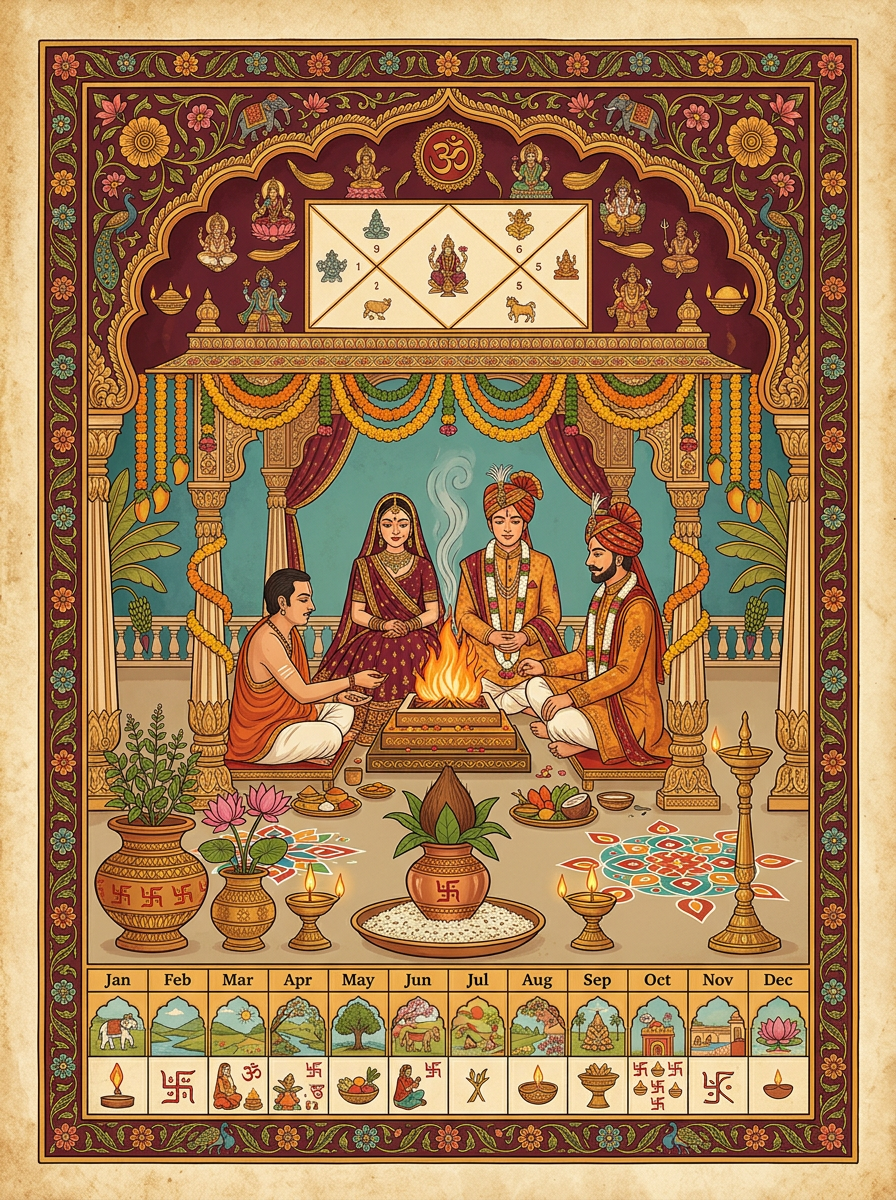
Planning a wedding is one of the most sacred, joyful, and complex milestones a family can undertake. In my practice at Daivagya, I sit with parents and young couples nearly every day who are trying to balance the realities of banquet hall bookings, caterers, and family travel with the timeless wisdom of the Vedic Panchang. Choosing an auspicious marriage muhurat is not about chasing superstitions; it is about harmonizing two unique soul blueprints with the prevailing cosmic rhythms to establish stability, mutual affection, and prosperity.
The upcoming cycle spanning late 2026 through mid-2027 is set to be an active, auspicious period for weddings across India and abroad. However, navigating this season requires a clear understanding of when planetary energies support new beginnings and when cosmic currents suggest a pause. Here is your comprehensive month-by-month outlook for the 2026–27 wedding calendar.
Why is the 2026–27 wedding season uniquely structured?
Every wedding season in Vedic astrology is governed by the interplay of celestial bodies, primarily the movement of the Sun (Surya), the strength of Jupiter (Guru), and the luminosity of Venus (Shukra). In the 2026–27 cycle, we observe distinct active windows punctuated by traditional periods of planetary combustion and solar ingress transitions.
When you look at wedding season dates over a multi-year horizon, no two years look identical. The shifting lunar calendar (Chandra Masa) relative to the solar year creates shifting dates for major festivals like Devuthani Ekadashi and Makar Sankranti, which traditionally mark the opening of wedding windows.
In late 2026 and early 2027, the planetary transits offer solid foundational support for couples, provided families steer clear of specific seasonal closures. By understanding these celestial patterns early, you can plan logistics months in advance without last-minute panic or compromises.
How do Vedic astrologers calculate an auspicious vivah muhurat?
A true wedding Muhurat is far more sophisticated than simply picking a weekend on the wall calendar. In classical Jyotish, calculating a Shuddha (pure) Vivah Muhurat involves analyzing the five fundamental limbs of time known as the Panchang:
- Tithi (Lunar Day): Auspicious Tithis like Dvitiya, Tritiya, Panchami, Saptami, Dashami, Ekadashi, and Trayodashi of the Shukla Paksha (waxing phase) and early Krishna Paksha are preferred. Rikta Tithis (4th, 9th, and 14th) are strictly avoided.
- Vara (Day of the Week): Thursdays (governed by Jupiter), Fridays (governed by Venus), Mondays (governed by the Moon), and Wednesdays (governed by Mercury) provide gentle, fertile energy for marital life.
- Nakshatra (Lunar Mansion): Classical texts celebrate Rohini, Mrigashira, Magha, Uttara Phalguni, Hasta, Swati, Anuradha, Moola, Uttara Ashadha, Uttara Bhadrapada, and Revati as prime marriage stars.
- Yoga: Auspicious Yogas like Siddha, Sadhya, Shubha, and Brahma are chosen, while harsh combinations like Vyatipata, Vaidhriti, and Atiganda are avoided.
- Karana: Active half-lunar days supporting constructive rites are chosen; Vishti (Bhadra) Karana is strictly omitted.
Beyond these five pillars, an astrologer evaluates the marriage Lagna (the exact rising sign during the ceremony). The 7th house of the Muhurat chart must remain completely unoccupied by malefic planets, and the 8th house must be free of afflictions to protect marital longevity.
Which major periods must be avoided during 2026 and 2027?
Before marking dates on your calendar, every family must understand the major seasonal windows where wedding ceremonies are traditionally paused. These pauses are rooted in deep astronomical and seasonal wisdom:
- Chaturmas (Four Holy Months): Beginning around Devshayani Ekadashi in July and ending on Devuthani Ekadashi in November, Lord Vishnu enters cosmic slumber (Yoga Nidra). Sustaining energy is internalized, making this a period for reflection and spiritual penance rather than worldly expansion and weddings.
- Kharmaas / Malmaas (Sun in Sagittarius and Pisces): When the Sun enters Jupiter’s signs (Dhanu in mid-December to mid-January, and Meena in mid-March to mid-April), solar vitality submits to spiritual Guru energy. Worldly celebrations pause during these weeks.
- Guru and Shukra Tara Asta (Combustion): Venus represents love, intimacy, and relationship bliss, while Jupiter represents grace, longevity, and marital wisdom. When either planet travels too close to the Sun, it loses its visible light (combustion or Asta), and wedding ceremonies are halted until the planet emerges.
- Holashtak: The eight days preceding the festival of Holi in early spring carry erratic planetary vibrations, during which major auspicious ceremonies are traditionally deferred in North Indian traditions.
Month-by-month vivah muhurat guide for late 2026
The initial phase of the 2026–27 season opens in late autumn 2026 after the conclusion of Chaturmas. Families looking to host winter weddings will find concentrated opportunities during these months.
November 2026
The wedding season officially awakens in November 2026 following Devuthani Ekadashi and Tulsi Vivah. As the divine sustaining forces reactivate, the atmosphere turns celebratory across the country.
- Auspicious Timing: Mid to late November offers several strong dates, especially around Anuradha, Hasta, and Uttara Phalguni Nakshatras.
- Astrological Character: The late autumn air provides pleasant planetary stability. It is an ideal window for grand, traditional ceremonies before winter peaks.
- Planning Tip: Dates immediately following Tulsi Vivah fill up quickly with venue bookings; secure your core arrangements well in advance.
December 2026
December is traditionally one of the most sought-after months for modern weddings due to favorable weather and holiday schedules.
- Auspicious Timing: Strong wedding dates concentrate in the first half of the month, from December 1st up until Dhanu Sankranti (around December 15–16, 2026).
- The Mid-Month Pause: Once the Sun enters Sagittarius (Dhanu), Kharmaas begins, and all Vivah Muhurats pause until mid-January 2027.
- Astrological Character: Early December carries steady lunar energies through Mrigashira and Rohini, offering warmth and emotional grounding for new couples.
Month-by-month vivah muhurat guide for early to mid 2027
Following the winter solstice and the harvest celebrations, the 2027 calendar reopens with vibrant energy and multiple auspicious stretches running through the summer.
January 2027
The wedding calendar resumes in mid-January 2027 after Makar Sankranti, when the Sun begins its northward journey (Uttarayana), bringing renewed vitality, clarity, and auspiciousness.
- Auspicious Timing: The latter half of January (post-January 15th) provides reliable windows under Uttara Ashadha and Rohini Nakshatras.
- Astrological Character: Uttarayana energy is considered exceptionally empowering for setting lifelong family intentions.
- Planning Tip: January evenings can be quite cold in North India; ensure your chosen Muhurat Lagna aligns comfortably with indoor heating or day-time ceremonies.
February 2027
February remains the crown jewel of the winter wedding season, boasting pleasant weather and an abundance of classical Panchang alignments.
- Auspicious Timing: Robust windows appear throughout the month, particularly around Vasant Panchami and through Nakshatras such as Hasta, Swati, and Magha.
- Astrological Character: Strong Shukra and Guru alignments during this month create romantic, harmonious, and socially vibrant environments for celebrations.
March 2027
March brings the vibrant onset of spring, but families must carefully navigate Holashtak and the impending Meena Kharmaas.
- Auspicious Timing: The early days of March provide select windows before the onset of Holashtak leading up to Holi.
- The Mid-Month Pause: Around mid-March (Meena Sankranti), the second Kharmaas of the cycle begins, pausing wedding rites until mid-April.
April 2027
April heralds the Hindu New Year, Chaitra Navratri, and Mesh Sankranti (when the Sun enters exalted Aries).
- Auspicious Timing: After the Sun enters Aries around April 14, 2027, excellent wedding dates open in late April under Swati, Anuradha, and Uttara Phalguni.
- Astrological Character: The exalted Sun infuses couples with dynamic leadership, health, and mutual respect.
May 2027
May represents one of the busiest months of the year for auspicious ceremonies, featuring Akshaya Tritiya—one of the most revered days in the Vedic calendar.
- Auspicious Timing: Generous dates span across the month, with Akshaya Tritiya acting as a universally self-proven (Siddha) Muhurat.
- Astrological Character: Rich in lunar stability, May allows for stable, expansive, and high-energy celebrations.
June and July 2027
As the summer reaches its peak, June and early July offer the final opportunities of the season before the cosmos rests once again for Chaturmas.
- Auspicious Timing: Strong dates continue through June and into early July 2027, culminating near Devshayani Ekadashi.
- Astrological Character: Rains begin to cool the land, symbolizing fertility, renewal, and blessing for couples starting their journey together.
- Seasonal Conclusion: Once Devshayani Ekadashi arrives in July 2027, the wedding calendar pauses for four months until late autumn 2027.
Key vivah muhurat windows for 2026–27 at a glance
To assist your family’s preliminary discussions, here is a consolidated overview of how the 2026–27 wedding calendar unfolds across both years.
| Month & Year | Astrological Status | Primary Supporting Nakshatras | Seasonal Focus / Considerations |
|---|---|---|---|
| Nov 2026 | Highly Auspicious | Anuradha, Uttara Phalguni, Hasta | Opens after Devuthani Ekadashi; high demand |
| Dec 2026 | Favorable (1st Half) | Rohini, Mrigashira | Pauses mid-month due to Dhanu Kharmaas |
| Jan 2027 | Favorable (2nd Half) | Rohini, Uttara Ashadha | Reopens post-Makar Sankranti; Uttarayana begins |
| Feb 2027 | Highly Auspicious | Hasta, Swati, Magha, Revati | Peak winter season; excellent planetary balance |
| Mar 2027 | Limited Windows | Mrigashira, Uttara Phalguni | Pauses for Holashtak and Meena Kharmaas |
| Apr 2027 | Favorable (2nd Half) | Anuradha, Swati, Hasta | Opens post-Mesh Sankranti (Exalted Sun) |
| May 2027 | Highly Auspicious | Rohini, Hasta, Uttara Ashadha | Includes Akshaya Tritiya; supreme abundance |
| Jun 2027 | Favorable | Mrigashira, Anuradha, Swati | Summer season; steady lunar transits |
| Jul 2027 | Early Month Only | Uttara Phalguni, Hasta | Season concludes at Devshayani Ekadashi |
Note: General Panchang dates provide community windows, but they must always be cross-checked with the individual charts of the bride and groom.
What is Tribala Shuddhi and why is personal chart alignment essential?
In my practice, I frequently encounter families who choose a date purely because a popular calendar marked it as auspicious, only to face unexpected friction during planning. The reason is simple: a universal date in the Panchang is only half of the equation. The other half is Tribala Shuddhi (three-fold planetary strength) specific to the couple.
       Universal Panchang Date (Tithi, Vara, Nakshatra, Yoga, Karana)
                                    +
                 Tribala Shuddhi (Personalized Strength)
      ┌─────────────────────────────┼─────────────────────────────┐
      ▼                             ▼                             ▼
Groom's Surya Bala           Bride's Guru Bala             Chandra Bala
(Solar Strength)            (Jupiter Strength)          (Transit Moon Strength)
Tribala Shuddhi evaluates three primary cosmic pillars:
- Surya Bala (Strength of the Sun): Evaluated primarily for the groom. The transit Sun on the wedding day must occupy a favorable house (3rd, 6th, 10th, or 11th from his natal Moon, or otherwise well-placed with proper propitiation). The Sun bestows vitality, purpose, and capability as a householder.
- Guru Bala (Strength of Jupiter): Evaluated primarily for the bride. Jupiter must transit favorably from her natal Moon (2nd, 5th, 7th, 9th, or 11th house) to grant lifelong protection, wisdom, and emotional contentment. If Jupiter is in an unfavorable transit, classical remedies or specific Nakshatra cushions are applied.
- Chandra Bala (Strength of the Moon): Evaluated for both individuals. The transit Moon on the wedding day should avoid the 6th, 8th, or 12th houses from their natal Moon signs to safeguard emotional peace and ensure smooth wedding rituals.
Before finalizing any banquet hall or invitation print run, you can check your natal Moon signs and core charts using our free kundli tool to ensure your preliminary dates align with your personal astrological profile.
How do Venus and Jupiter combustion affect wedding dates in this cycle?
In classical Vedic astrology, Venus (Shukra) and Jupiter (Guru) are the two great natural benefics (Shubha Grahas). They carry the vital energies that nourish human unions:
- Venus is the significator (Karaka) of physical attraction, romantic refinement, comfort, and marital harmony.
- Jupiter is the significator of divine grace, ethics, dharma, fertility, and long-term marital stability.
When either of these planets passes behind the Sun from Earth’s vantage point, it undergoes combustion (Asta or Tara Asta). During combustion, the visible spiritual rays of the planet are obscured by intense solar glare. Classical masters like Sage Parashara and Sage Varahamihira strictly advise against conducting sacramental marriages during these combust phases.
During the vivah muhurat 2026-27 cycle, astrologers keep a close watch on these planetary ephemerides. Even if a particular day has a supportive Tithi and Nakshatra, if Shukra or Guru is combust, that date is excluded from the authenticated Shuddha Vivah calendar. Respecting this principle protects the couple from entering a bond during a time of diminished planetary support.
How should families coordinate venue bookings with astrological timing?
In major metropolitan hubs like Noida, Delhi NCR, Mumbai, and Bengaluru, families often face severe practical bottlenecks when booking venues. A date might be astrologically sublime, but banquets are unavailable, or caterers are stretched thin. How do we resolve this modern dilemma?
In my consultations, I encourage families to adopt a collaborative, phased strategy:
- Identify a Window, Not Just a Single Day: Instead of fixing your heart on one single evening, identify 3 to 4 strong Muhurat options within your preferred month.
- Check Lagna Flexibility: A single calendar date contains multiple rising signs (Lagnas) across 24 hours. While evening Godhuli or Vrishabha (Taurus) Lagna is popular, an early morning Mithuna (Gemini) or afternoon Kanya (Virgo) Lagna might offer an even stronger chart configuration without requiring you to compete for peak banquet hours.
- Coordinate Early Kundli Verification: Review the couple's personal charts six to nine months before the intended season. This prevents the heartbreak of making heavy financial deposits on dates that ultimately clash with the bride’s Guru Bala or the groom’s Surya Bala.
By approaching the planning process with flexibility and astrological foresight, you can secure high-quality venues while maintaining complete fidelity to sacred Vedic timing.
What if an unavoidable family date clashes with a traditional muhurat?
Real life involves diverse considerations—such as the availability of overseas relatives, professional exam schedules, or unexpected logistical constraints. What should a family do if their only feasible gathering date does not feature a classical full-day Muhurat?
Classical Jyotish provides thoughtful adaptations for such situations:
- Abhijit Muhurat: Occurring daily around midday (approximately 24 minutes before and after local solar noon), Abhijit Muhurat is blessed directly by Lord Vishnu. It carries inherent potency to clear minor doshas when an evening window is unavailable.
- Godhuli Vela: Occurring right around sunset as cattle traditionally returned home, Godhuli Vela is recognized as a gentle, naturally blessed period suitable for specific community celebrations when standard planetary alignments are moderate.
- Lagna Shuddhi Rectification: An experienced astrologer can mathematically calculate a rising Lagna that places Jupiter or Venus in an angle (Kendra) or trine (Trikona), effectively neutralizing minor blemishes in the daily Panchang.
If your family is navigating competing schedules or trying to find harmony between logistical realities and astrological tradition, you can book a consultation for a comprehensive, personalized chart analysis. Together, we can identify a balanced, auspicious path forward tailored specifically to your family's needs.
Frequently asked questions
Can we marry during Kharmaas if a special puja is performed?
No, traditional Vedic astrology strictly avoids Vivah during Kharmaas (when the Sun transits Sagittarius and Pisces). During these periods, the Sun's worldly vitality submits to introspective, spiritual Guru energy, making it unsuitable for initiating householder life.
How far in advance should we fix our wedding Muhurat?
I advise families to finalize their wedding Muhurat six to nine months in advance. This allows sufficient time to ensure Tribala Shuddhi for the couple, select the ideal rising Lagna, and secure venues without logistical stress.
Is Akshaya Tritiya always auspicious for every single couple?
While Akshaya Tritiya is a universally self-proven (Siddha) Muhurat that requires no general Panchang calculation, the personal Moon sign (Chandra Bala) of both partners must still be verified to ensure smooth, peaceful rituals on that day.
What is the difference between a day wedding and a night wedding astrologically?
Astrologically, the difference lies in the rising sign (Lagna) active during the vows. Day weddings often utilize Aries, Taurus, or Gemini Lagnas, while night weddings use Scorpio, Sagittarius, or Capricorn, each producing a different Muhurat chart.
Can an unfavorable transit of Jupiter for the bride be mitigated?
Yes. If Jupiter’s transit from the bride’s natal Moon is temporarily challenging, an astrologer evaluates Jupiter’s position in the Navamsha (D9) chart and can identify specific Nakshatra charanas or remedial prayers to balance the energy effectively.
Continue reading
Dev Uthani Ekadashi and Tulsi Vivah 2026 (20-21 November): When the Wedding Season Truly Begins
Discover the spiritual and astrological significance of Dev Uthani Ekadashi and Tulsi Vivah 2026, marking the official opening of the Hindu wedding season.
Kartik Purnima 2026 (24 November): What This Full Moon Means for Married Couples
Discover how Kartik Purnima 2026 influences marital harmony, emotional balance, and shared prosperity, along with traditional rituals and astrological insights.
Karwa Chauth 2026 (29 October): The Astrology Behind the Vrat and What It Means for Your Marriage
Discover the deep astrological significance of Karwa Chauth 2026 on 29 October, the cosmic influence of the Moon, and how this sacred fast supports marriage.
How to Choose Your Wedding Date: A Complete Vivah Muhurat Guide for Families
A comprehensive guide for families on selecting an auspicious wedding date using Vedic Muhurat principles, Panchang alignment, and personalized chart matching.
New here? Start with the full guide to Vivah Muhurat: Choosing the Right Wedding Date, or try the free kundli tool.
Want your specific situation analysed?
Book a private Marriage & Relationship Consultation with Dr. Rahul Singh — your charts read in detail, with a clear, confidential opinion you can act on.
Limited offer · was ₹15,000 · One-time payment · 60-minute personal consultation