12 October 2026 · Daivagya
Diwali 2026 (8 November): Lakshmi Puja Rituals Couples Do for a Harmonious Home
Discover essential Lakshmi Puja rituals for Diwali 2026 (8 November) designed for married couples to enhance peace, prosperity, and emotional harmony at home.
Quick answer
Performing Lakshmi Puja together on Diwali 2026 offers married couples a meaningful opportunity to harmonize domestic energies and invite lasting prosperity. By aligning rituals with the fixed Pradosh Kaal muhurat, participating jointly in the Sankalpa, and performing traditional offerings, couples can soothe household friction and nurture a deeply supportive environment for the year ahead.
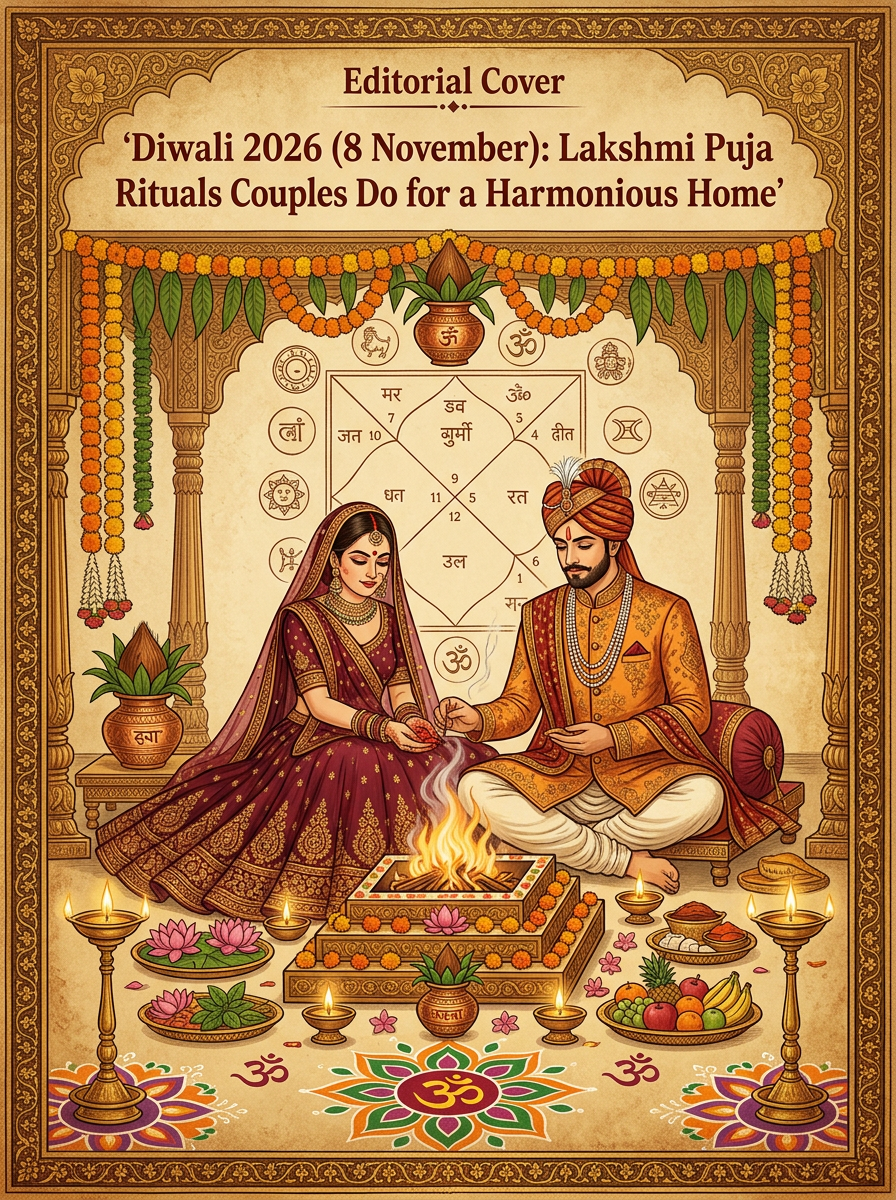
In my years of practicing Vedic astrology in Noida, I have observed that festival nights carry a distinctive astrological weight. Among all annual planetary alignments, Kartik Amavasya—the sacred night of Diwali—holds an unparalleled capacity to reset domestic atmosphere. On November 8, 2026, couples have an extraordinary celestial window to not merely pray for material wealth, but to anchor peace, emotional stability, and mutual respect within their living spaces.
Many couples visit my consultation room feeling drained by everyday domestic friction, mismatched temperaments, or unspoken financial stress. They often ask me if a specific ritual can help calm their home environment. The answer lies in understanding that Goddess Lakshmi is not just the bringer of monetary gains; in Vedic thought, She represents Shri—the total presence of grace, auspiciousness, sweetness in communication, and contentment in domestic life.
When a husband and wife sit side by side to perform Diwali Lakshmi Puja for couples, they are consciously balancing the planetary energies that govern their shared roof. In this comprehensive guide, I will walk you through the astrological timing, step-by-step rituals, and planetary understandings needed to make Diwali 2026 a turning point for your household peace.
Why does Diwali hold special astrological significance for married couples?
From a Vedic perspective, Amavasya is the phase where the Sun and Moon occupy the exact same sign. The Sun represents the soul, ego, and masculine cosmic principle (Surya/Shiva), while the Moon governs the mind, emotions, and feminine receptive principle (Chandra/Shakti). When these luminaries meet in Libra (Tula rashi)—the natural seventh house of the zodiac representing partnership and balance—a rare opening occurs to harmonize personal differences.
In every household, the fourth house of the chart governs domestic happiness (Sukhasthana), while the second house governs family speech and accumulated wealth (Kutumbasthana). When couples perform rituals together on Diwali night, the combined intentional energy pacifies malefic planetary influences affecting these specific life areas.
I often remind couples that Goddess Lakshmi resides permanently where there is mutual respect, cleanliness, and harmony between partners. When a home is filled with sharp speech or emotional withdrawal, the energy of Alakshmi (discord and stagnation) takes root. Participating in Lakshmi Puja rituals for marital harmony helps clear lingering emotional residue accumulated over the past year, restoring the home's subtle vibration.
What is the auspicious Muhurat for Lakshmi Puja on November 8, 2026?
In Vedic timing, performing rituals during a Sthira Lagna (Fixed Ascendant) is essential for prayers aimed at stability. A fixed sign ensures that the blessings of peace and abundance remain anchored in your home rather than fluctuating. On the evening of November 8, 2026, the ideal window falls during Pradosh Kaal when Vrishabha (Taurus) Lagna prevails.
Taurus is ruled by Venus (Shukra), the planet of love, luxury, marital harmony, and aesthetic beauty. Performing your puja while Taurus rises ensures that Venusian blessings infuse your domestic life with gentleness, affection, and economic security.
| Muhurat Segment | Approximate Window (IST) | Astrological Significance |
|---|---|---|
| Pradosh Kaal | 05:35 PM – 08:12 PM | Ideal time for sunset prayers and domestic lighting |
| Vrishabha Lagna (Fixed) | 06:15 PM – 08:10 PM | Most auspicious for couples performing joint Lakshmi-Ganesha Puja |
| Maha Nishita Kaal | 11:38 PM – 12:31 AM | Deep meditative window for mantra japa and inner healing |
Note: Exact sunset timings vary slightly across regions. Please check local panchang alignments for your city.
If you cannot perform the full puja during Vrishabha Lagna due to family schedules, the broader Pradosh Kaal window remains deeply supportive. Avoid performing the primary family puja during moving ascendants (Chara Lagna) if your core intention is long-term domestic stability.
How should a couple prepare their home together before Amavasya?
Preparation for Diwali is not just an aesthetic chore; it is an active cleansing of stale energetic patterns. In my practice, I encourage couples to view pre-Diwali decluttering as a joint spiritual exercise rather than a domestic burden.
To prepare your living space effectively:
- Clear the North-East (Ishanya) and South-East (Agneya) zones: The North-East controls spiritual clarity and Jupiter's grace, while the South-East governs the fire element (Venus). Clear out broken appliances, unread paper stacks, and dark clutter from these directions.
- Mop with rock salt and cow urine (Gomutra): Doing this three days leading up to Diwali purges accumulated negativity, harsh arguments, and heavy psychic atmosphere from the walls and floors.
- Adorn the threshold (Dehli): The main door is the mouth through which cosmic energy enters. Place fresh mango leaves (Toran), marigold garlands, and a clean swastika at the entrance to welcome benevolent forces.
- Ensure no leaky taps remain: Water waste in the North or North-East directly correlates with unnecessary emotional friction and erratic financial outflows.
When spouses divide these tasks with joy rather than resentment, the psychological and energetic tone of the house lifts well before the puja evening arrives.
Which specific Lakshmi Puja rituals strengthen emotional bonding between spouses?
Rituals work because they translate abstract intentions into physical, sacred actions. When both partners actively engage in each step rather than one spouse observing passively, the energetic alignment becomes twice as potent.
1. The Joint Sankalpa
Before lighting the first diya, sit side by side facing East or North. The husband traditionally sits on the right, and the wife sits on the left (the place of Shakti). Take water, raw rice (Akshata), a coin, and a flower in your right palm. Together, mentally state your names, gotra, location, and your joint prayer—not just for wealth, but for patience, mutual understanding, and peace in your home. Gently release the water into a copper vessel.
2. The Lighting of the Ghee Akhanda Diya
Light a large four-wick earthen or brass diya filled with pure cow ghee. This diya should ideally remain lit through the night. Cow ghee carries the cooling, benevolent energy of Jupiter and the Moon, which directly calms heated tempers and fiery Mars-Rahu influences in the household. Both partners should hold the match or lighting taper together to ignite this flame.
3. Offering Lotus Flowers and Kheer
Goddess Lakshmi is drawn to purity and sweetness. Offer two fresh pink lotus flowers (or red roses if lotus is unavailable) and home-cooked rice kheer prepared with saffron, milk, and cardamom. In Vedic astrology, milk and rice represent the Moon (mind and emotions), while saffron and cardamom pacify Mars and Venus. Sharing this prasad together after the puja acts as an inner remedy for softening harsh speech between partners.
4. Recitation of the Sri Suktam
The Sri Suktam from the Rig Veda is one of the most powerful sound frequencies for balancing household prosperity and emotional tranquility. If neither of you is fluent in Sanskrit chanting, play an authentic recording softly and follow along with folded hands. The sound vibrations resonate through the 4th house of your living space, dissolving lingering discord.
What role do planetary houses (4th, 7th, and 12th) play in household peace?
When I evaluate a couple's charts at Daivagya, domestic harmony is never judged solely by the 7th house of marriage. Marital life is supported by an intricate triangle of houses that directly respond to festival rituals:
- The 4th House (Domestic Happiness & Peace): This house represents your physical home and emotional contentment (Matribhava and Sukhasthana). When afflicted by Mars, Saturn, or Rahu, the home becomes a place of restlessness where partners cannot unwind. Diwali rituals specifically cleanse the fourth house vibrations of the family space.
- The 7th House (Interpersonal Partnership): Governed naturally by Venus, this house rules how you relate, negotiate, and show affection to your spouse. Honoring Goddess Lakshmi and Lord Ganesha restores the mutual goodwill required to keep the seventh house strong.
- The 12th House (Subconscious Rest & Intimacy): The twelfth house rules bedroom harmony, private thoughts, and the ability to let go of grudges. Lighting mustard oil diyas outside the house and placing a fragrant ghee lamp in the safe areas of the bedroom helps clear heavy twelfth-house blockages.
To explore how these specific houses are configured in your individual birth chart, you can generate your planetary details using our free kundli tool.
How can you align your Diwali offerings based on your birth chart?
While standard rituals benefit everyone, tailoring certain elements to planetary strengths elevates the effect of astrological remedies for a peaceful home.
Here is how you can gently align your joint offerings based on the prominent planetary needs in your life:
+-------------------+------------------------------------+---------------------------------------+
| Planetary Focus   | If You Experience...               | Recommended Diwali Addition           |
+-------------------+------------------------------------+---------------------------------------+
| Venus (Shukra)    | Lack of warmth, romance, affection | Offer white scented flowers & ittar   |
| Moon (Chandra)    | Mood swings, anxiety, domestic tear| Offer silver coin washed in raw milk  |
| Jupiter (Guru)    | Disagreements on values & growth   | Offer yellow sweets & turmeric roots  |
| Mars (Mangal)     | Quick tempers, ego clashes         | Offer pomegranate & red sandalwood    |
| Mercury (Budh)    | Misunderstandings & poor dialogue  | Offer green cardamom & fresh durva    |
+-------------------+------------------------------------+---------------------------------------+
Integrating these subtle elements does not require elaborate rituals. Simply place the selected offering near the Lakshmi-Ganesha idol with clean devotion during the main puja.
What are the most common mistakes couples make during Diwali Puja?
In my observations over the years, the spiritual benefits of Diwali are often neutralized by simple, preventable mistakes made in the rush of the festival.
- Entering the Puja with Unresolved Anger: The emotional state of the performers matters far more than the cost of the puja items. Rushing, shouting at family members during preparation, or sitting down for aarti while carrying silent resentment blocks the reception of grace. Take ten minutes to sit quietly together and breathe before beginning.
- Ignoring Lord Ganesha: Goddess Lakshmi should never be worshipped alone for domestic harmony; She must always be accompanied by Lord Ganesha, who removes pride and removes obstacles. Ganesha's presence ensures that prosperity is accompanied by wisdom (Buddhi).
- Using Broken or Cracked Idols: Always inspect clay or metal idols carefully. A chipped idol or cracked diya should never be used in a sacred setting.
- Leaving the North-East Dark: While diyas are placed across the entire home, ensure the North-East corner has an unbroken light source throughout the night. Darkness in this corner invites mental fog and confusion into family matters.
What practical post-Puja habits keep the festive harmony alive all year?
A common lament I hear from clients in Noida is that the peaceful feeling of Diwali evaporates within forty-eight hours. The energy raised on Diwali night must be protected through simple, practical lifestyle habits:
- Maintain the Sacred Threshold: Keep your main entrance clean and well-lit every evening, not just on festive days. Lighting a single ghee diya near the threshold at dusk invites continuous Venusian and lunar peace.
- Mindful Speech at Meal Times: The second house of your chart rules both food and speech. Make a conscious pact to avoid discussing contentious topics, finances, or family grievances while sharing meals.
- Weekly Joint Prayers: Spending even five minutes together every Friday evening lighting a lamp and offering a single fragrant incense stick keeps the Diwali sankalpa alive through the changing planetary transits of the year.
When should couples seek personalized astrological guidance for home remedies?
While collective festival rituals offer universal upliftment, there are times when domestic stress stems from deeper chart dynamics. If your home experiences chronic, unexplainable friction, severe sleep disruptions, or recurring financial blockages despite repeated efforts, the underlying planetary root may involve specific dasha periods or strong afflictions to the 4th, 7th, or 8th houses.
In such situations, generalized remedies can only take you so far. An individualized analysis of both horoscopes helps identify whether the discord is driven by a difficult Saturn transit, Rahu-Ketu nodal axes across relationship houses, or an unaddressed Mangal influence.
If you feel that deeper astrological clarity could help bring peace to your domestic life, I invite you to book a consultation with me at Daivagya. Together, we can examine both charts in detail, understand the planetary currents at play, and design quiet, practical remedies suited precisely to your life.
May this Diwali on November 8, 2026, illuminate your household with profound peace, mutual understanding, and enduring grace.
Frequently asked questions
Can a couple perform Lakshmi Puja if one spouse is away from home?
Yes, distance does not prevent spiritual alignment. The spouse at home can place a photograph or mental representation of their partner beside them during the Sankalpa. The absent spouse should pause at the same muhurat time, light a simple lamp wherever they are, and mentally connect with the household prayer.
Is it necessary to stay awake all night during Diwali for domestic blessings?
Staying awake all night (Jagran) is beneficial during Maha Nishita Kaal for deep meditation, but it is not mandatory for domestic peace. What matters most is performing the Pradosh Kaal puja with complete presence, calmness, and mutual devotion, followed by a peaceful, restful night in a cleaned space.
Which idol placement is astrologically correct for Lakshmi and Ganesha?
When facing the altar, place Lord Ganesha to the left of Goddess Lakshmi (which is Lakshmi's right side). Ganesha is treated as Her blessed spiritual son in this context. Placing Ganesha to Her right creates the mother-son dynamic that invites auspicious, stable prosperity into the household.
Should we keep the Diwali diyas burning throughout the night?
Yes, especially the central Akhanda Diya filled with pure cow ghee. Keeping at least one central lamp burning uninterrupted in your puja space preserves the protective Agni (fire) element, keeping negative astral influences and domestic heaviness away from your living space until sunrise.
What should we do with the flowers and offerings the morning after Diwali?
Treat all sacred materials with deep respect. Never discard puja flowers or mango leaves into standard household trash. Collect them gently the following morning and place them under a clean tree, in a garden bed, or immerse them in flowing water so their sacred prana returns naturally to the earth.
Continue reading
Dev Uthani Ekadashi and Tulsi Vivah 2026 (20-21 November): When the Wedding Season Truly Begins
Discover the spiritual and astrological significance of Dev Uthani Ekadashi and Tulsi Vivah 2026, marking the official opening of the Hindu wedding season.
Kartik Purnima 2026 (24 November): What This Full Moon Means for Married Couples
Discover how Kartik Purnima 2026 influences marital harmony, emotional balance, and shared prosperity, along with traditional rituals and astrological insights.
Chhath Puja 2026 (14-15 November): Strengthening the Sun for Family Wellbeing
Discover how Chhath Puja 2026 offers a sacred window to strengthen the Sun in your birth chart, fostering deep family vitality, dignity, and marital harmony.
Dhanteras 2026 (6 November): Prosperity Rituals for a Newly Married Home
A complete astrological guide to Dhanteras 2026 on 6 November for newly married couples, covering shubh muhurat, auspicious purchases, and joint rituals.
Want your specific situation analysed?
Book a private Marriage & Relationship Consultation with Dr. Rahul Singh — your charts read in detail, with a clear, confidential opinion you can act on.
Limited offer · was ₹15,000 · One-time payment · 60-minute personal consultation