28 August 2026 · Daivagya
Two Astrologers, Two Opinions: Whom Should You Trust?
Confused by contradictory horoscope predictions? Learn why skilled astrologers differ in their readings and how to determine which guidance is truly reliable.
Quick answer
Contradictory astrological opinions usually stem from differences in calculation systems, ayanamsa, house systems, and the depth of chart analysis. Rather than trusting fatalistic claims or fear-based remedies, choose the practitioner who transparently explains the astrological logic, cross-checks divisional charts, and focuses on constructive guidance.
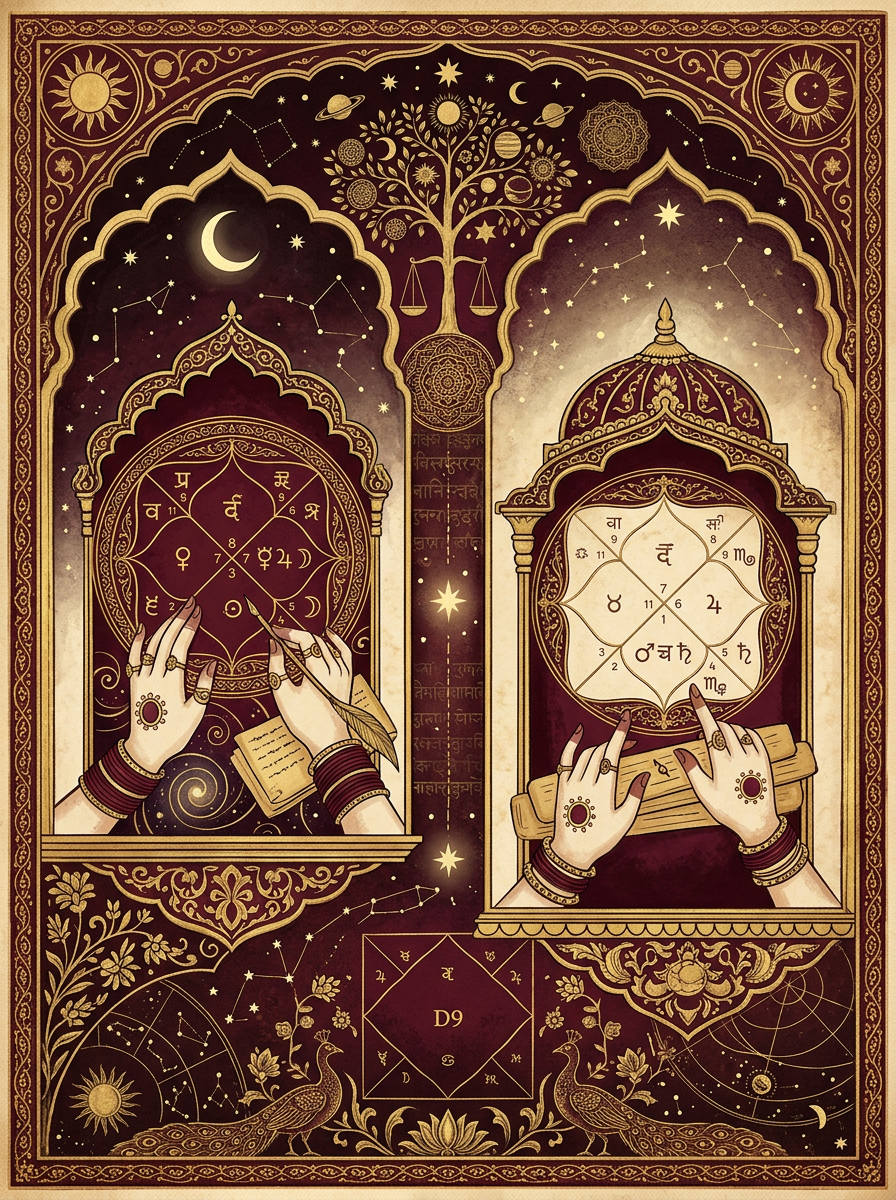
It is one of the most unsettling experiences in astrology: you visit one practitioner who tells you that your marriage will happen smoothly within six months, and a week later, another practitioner reviews the exact same birth details and warns of severe delays, difficult doshas, and insurmountable hurdles.
In my practice at Daivagya in Noida, I see families and young professionals facing this exact dilemma almost every week. When you receive conflicting astrological advice, the natural reaction is anxiety and skepticism. You wonder whether Vedic astrology is arbitrary or whether one of the practitioners simply made a mistake.
The truth is more nuanced. Astrology is both a precise mathematical science and a sophisticated interpretive discipline. Understanding why different practitioners arrive at divergent conclusions will help you separate genuine insight from superficial readings and decide whose guidance to trust.
Why do two astrologers see different outcomes in the same birth chart?
When two practitioners look at your birth chart, they are rarely looking at a single, static image. Vedic astrology comprises multiple analytical layers, and different astrologers assign different weight to these layers.
First, there is the question of depth. A surface-level reading might look only at your primary birth chart (the Rashi or D1 chart) and your current running Mahadasha. A deeper reading, however, cross-references the Navamsha (D9) chart, evaluates planetary strength through Shadbala, and checks the actual positions of planets in the Bhava Chalit chart.
I have seen many instances where a planet appears weak or afflicted in the basic birth chart, prompting one astrologer to declare a severe problem. A more thorough astrologer, however, will notice that the same planet is exalted or well-placed in the Navamsha chart, completely reversing the initial negative assessment. Neither astrologer invented anything, but one stopped reading at the surface while the other analyzed the full picture.
If you want to verify your basic planetary placements before consulting anyone, you can generate your foundational chart using our free kundli tool to see how your planetary degrees and houses are mapped.
Is one astrologer using a different calculation system?
Discrepancies often arise from technical differences in the calculation models that practitioners follow behind the scenes. While both may practice Vedic astrology, their underlying mathematical settings may not be identical.
Here are the most common technical variations that cause differences in predictions:
- Ayanamsa Settings: The Ayanamsa accounts for the precession of the equinoxes. While the Lahiri (Chitra Paksha) ayanamsa is the standard recognized in India, some astrologers use Raman, Krishnamurti (KP), or KP Straight Line settings. A difference of even one degree can shift a planet into a different nakshatra or change the operational dates of your Dasha periods by several months.
- House Division Systems: Traditional Parashari astrology uses equal house divisions based on the rising sign (Rashi-based houses). Other traditions, such as KP or Sripati, calculate house cusps based on latitude, meaning a planet in your 7th sign might technically sit in your 6th house of obstacles.
- Dasha Calculation Bases: While most practitioners calculate the Vimshottari Dasha from the Moon's Nakshatra, specialized techniques calculate Dashas from the Lagna (Ascendant) or use conditional Dashas like Yogini or Chara Dasha when specific planetary conditions are met.
When mathematical baselines differ, the timing of life events and the assessment of strength will naturally vary.
Why do marriage compatibility readings vary so wildly?
Nowhere is the problem of conflicting advice more common than in relationship compatibility. You might find that one family elder runs an automated 36-point Guna Milan and declares a match incompatible due to low points or a perceived dosha, while an experienced consultant gives the union a green light.
This happens because basic kundli matching discrepancies occur when an analyst relies solely on scorecards rather than holistic compatibility. Vedic texts clearly state that Guna Milan accounts for only a fraction of marriage compatibility.
| Evaluation Element | Basic / Automated Approach | Advanced Vedic Synthesis |
|---|---|---|
| Guna Score (Ashtakoot) | Strict cutoff (e.g., under 18 rejected) | Assessed in context of overall planetary friendship |
| Mangal Dosha | Checked only from Lagna; deemed absolute | Evaluated from Lagna, Moon, and Venus with cancellation rules |
| Navamsha (D9) | Often omitted entirely | Mandatory for evaluating emotional harmony and longevity |
| Longevity & Health | Assumed from basic score | Independently checked in 8th and 1st houses of both charts |
| Dasha Synchronization | Ignored | Checked to ensure supportive life periods run concurrently |
When an astrologer applies classical cancellation rules (Parihara), a severe-looking flaw often resolves naturally. An astrologer who ignores these cancellations will sound an alarm, while one who studies them will calmly explain why the chart is safe.
How does the astrologer's personal philosophy shape the reading?
Vedic astrology is an observational science filtered through the human mind. The practitioner's mindset, ethical framework, and life experience inevitably influence how they translate ancient planetary principles into real-world counsel.
In our tradition, Vedic astrology interpretation should illuminate your path, build inner resilience, and provide clarity. Unfortunately, some practitioners practice fatalistic astrology. They view every planetary blemish as an inevitable catastrophe and often prescribe costly, fear-inducing measures to remedy it.
Other practitioners view a birth chart as a map of karmic tendencies and psychological inclinations. When a constructive astrologer spots Saturn or Mars influencing the 7th house, they will not tell you that your married life is doomed. Instead, they will explain that your relationship requires patience, clear communication boundaries, and conscious effort during specific transit periods.
Both astrologers identified the same planetary aspect, but their philosophy dictated whether the advice left you empowered or paralyzed with anxiety.
What questions should you ask to decide whom to trust?
When you are caught between two contradictory readings, you do not have to guess blindly. You can test the quality of an astrological consultation by asking specific, clarifying questions.
Look for these markers to determine which practitioner is giving you dependable guidance:
- Did they explain the reasoning? A reliable astrologer should be able to explain why they reached a conclusion. If you ask why marriage is delayed and they cite the specific Dasha and Saturn's transit over the 7th lord, they are working from structured principles.
- Did they examine divisional charts? Ask if they checked your Navamsha chart. If a practitioner makes sweeping claims about your marriage without opening the D9 chart, their analysis is incomplete.
- Was the tone fear-based or constructive? Genuine Vedic wisdom never relies on creating panic. If someone insists that immediate calamity will strike unless you perform an extravagant ritual, step back.
- Did they ask about your lived reality? Astrology operates within the context of your environment, culture, and personal background. An astrologer who listens carefully before concluding is far more reliable than one who delivers generic, one-size-fits-all proclamations.
How should you handle contradictory remedies?
Another common area of confusion is when two astrologers recommend opposing remedies—for example, one advises wearing a yellow sapphire for Jupiter, while another warns that Jupiter is a functional malefic for your ascendant and suggests chanting mantras instead.
In my practice, I always urge people to err on the side of caution with physical items like gemstones. Gemstones amplify planetary energies directly; if prescribed incorrectly for a planet that rules difficult houses, they can increase restlessness or friction. On the other hand, non-invasive remedies—such as traditional stotram chanting, disciplined lifestyle habits, meditation, and mindful charitable acts—are universally beneficial and never cause harm.
If you receive conflicting gemstone recommendations, pause. Do not wear any stone until you have reconciled the planetary rulerships of your chart with a clear, logical explanation.
Making a clear, confident decision
When faced with two differing opinions, remember that astrology is meant to serve your discernment, not replace it. You are not bound by the harshest prediction you hear, nor should you blindly accept an unrealistically flattering one.
Look for the practitioner whose reading feels coherent, intellectually honest, and aligned with your known life patterns. The right guidance will leave you with practical clarity, a balanced perspective on upcoming timing windows, and a calm mind.
If you find yourself caught between conflicting charts, confusing scores, or unsettling predictions about your life and relationships, you are welcome to book a consultation with me at Daivagya. Together, we will review your chart step by step, explain the exact astrological logic behind your planetary periods, and provide balanced, constructive guidance you can trust.
Continue reading
Your First Consultation: What to Expect, Step by Step
Wondering what happens during your first Vedic astrology reading? Here is a transparent, step-by-step walkthrough of the consultation process and how to prepare.
How Malefic Venus Can Cause a Bad Relationship and Married Life: Signs and Remedies
Discover how an afflicted or malefic Venus impacts marital harmony, recognizable behavioral signs in relationships, and practical Vedic remedies to restore warmth.
Karwa Chauth 2026 (29 October): The Astrology Behind the Vrat and What It Means for Your Marriage
Discover the deep astrological significance of Karwa Chauth 2026 on 29 October, the cosmic influence of the Moon, and how this sacred fast supports marriage.
Stress, Sleep and the Moon in Married Life
Discover how the Moon's placement influences sleep quality, emotional stress, and daily harmony in your marriage through the lens of Vedic astrology.
Want your specific situation analysed?
Book a private Marriage & Relationship Consultation with Dr. Rahul Singh — your charts read in detail, with a clear, confidential opinion you can act on.
Limited offer · was ₹7,500 · 60-minute consultation + detailed written analysis