4 August 2026 · Daivagya
Kundali Matching by Name and Date of Birth: How Accurate Is It Really?
Name-based gun milan is everywhere online. Here is what it can genuinely tell you, where it breaks down, and why birth-time matching remains the standard.
Quick answer
Kundali matching by name and date of birth provides a general overview of lunar compatibility but lacks the precision of a full horoscopic analysis. While birth dates narrow down the moon sign, the absence of an exact birth time prevents the calculation of the ascendant and planetary houses. This method serves as a preliminary screening tool rather than a definitive guide for lifelong marital success.
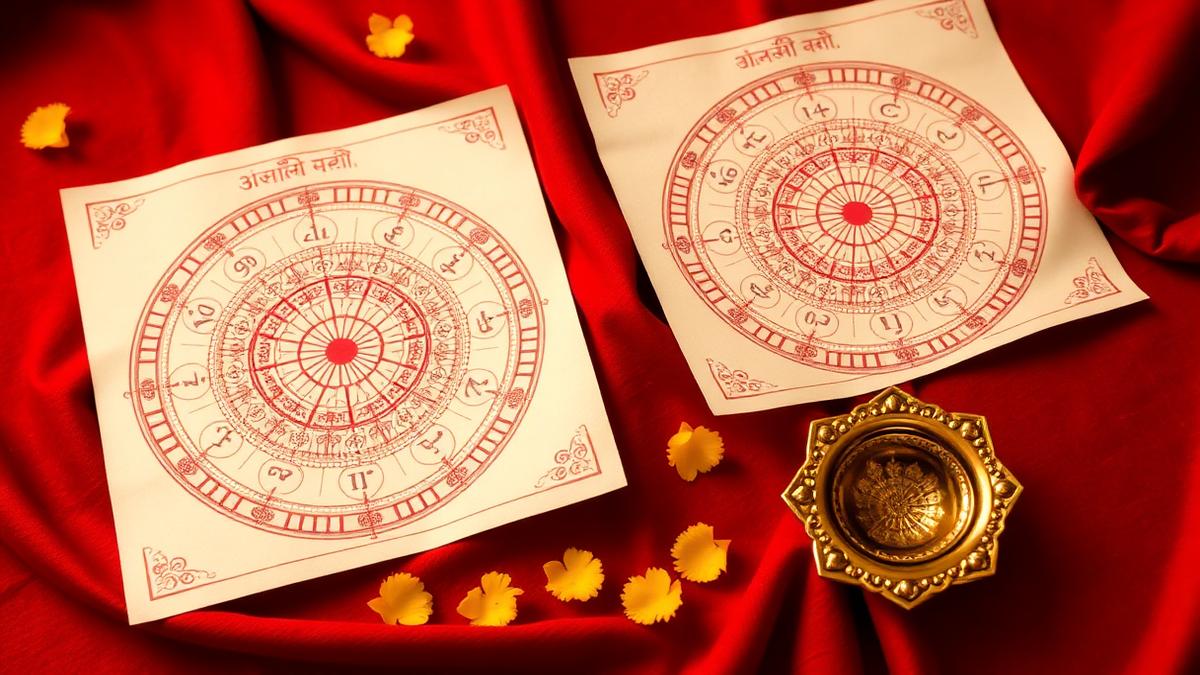
Almost every family that comes to me has already run a match online. Sometimes with full birth details, very often with just two names. The score comes back, and the family arrives either relieved or frightened.
Since the question keeps repeating, let me answer it directly: how accurate is kundali matching by name and date of birth?
Where name matching comes from
Name-based matching is not invented by websites. It rests on a genuine older practice — namakshar — where the first syllable of a person''s name is linked to a nakshatra pada. Traditionally, the name itself was chosen from the birth nakshatra, so the syllable pointed back to the true Moon position.
The logic worked because the name came from the chart. Today it usually does not.
Why it breaks down now
Most people are named for family reasons, not from the janma nakshatra. Add to this:
- Nicknames and shortened names used in daily life
- Spelling variations across documents
- English transliteration changing the first syllable entirely
- Names chosen for numerology after birth
Once the name no longer derives from the Moon''s nakshatra, name matching is estimating the very thing the whole calculation depends on.
What date of birth adds — and what it still misses
Adding the date of birth is a real improvement. It fixes the Moon''s rashi within a day and narrows the nakshatra considerably.
But the Moon moves about one nakshatra every 24 hours or so. Without the time of birth, a match run on the date alone can land on the wrong nakshatra, and with it the wrong Yoni, Gana, Bhakoot and Nadi readings. Those four koots carry 24 of the 36 points.
More importantly, the date alone gives no lagna. No lagna means no 7th house, no 8th house, and no reading of the marriage itself.
The accuracy ladder
Here is how I rank the three approaches for families who want a plain answer:
- Name only — indicative at best. Fine for curiosity, not for a decision.
- Name and date of birth — reasonably reliable for rashi-level compatibility, still blind to the houses and dashas.
- Full birth details for both — date, exact time and place. This is the standard on which a marriage decision should rest.
What proper matching examines
When both charts are cast correctly, the reading covers:
- Ashtakoot guna milan — the 36-point score, read koot by koot rather than as a total
- Mangal dosha and its cancellations in both charts
- Nadi and Bhakoot dosha, and whether they are genuinely applicable
- The 7th and 8th houses, the 7th lords, and Venus and Jupiter in each chart
- Dasha alignment — whether the two life-periods run in step over the coming years
- Indications of temperament, health, finances and family life
A name-based tool can offer none of this.
So should you ignore online tools completely?
No. Use them the way you would use a thermometer, not a diagnosis. If a free tool with correct birth details shows a low score, treat it as a prompt for a proper reading. If it shows a high score, do not treat that as clearance either — I have seen 30-point matches struggle and 18-point matches thrive.
The score opens the conversation. It does not close it.
Get the match read properly
If a proposal is being discussed in your family, bring both horoscopes — date, exact time and place of birth for each person — and I will read them together with you, explain what genuinely matters, and tell you plainly what I see.
Consultations are online by video, so distance is not a problem. You can book a compatibility reading here.
Continue reading
Every Marriage Dosha in One Place: A Reference Guide
A complete, clear reference guide to every major marriage dosha in Vedic astrology, including Manglik, Nadi, Bhakoot, and planetary combinations.
Two Manglik Charts, One Peaceful Home: A Reading
Discover how two Manglik charts can create a balanced, thriving marriage through mutual planetary alignment, conscious communication, and classical Vedic insight.
Manglik Dosha: The Complete Guide to Mangal Dosh, Its Real Effects and Working Remedies
Demystify Manglik Dosha with an honest Vedic astrology guide covering house placements, genuine marital effects, natural cancellations, and working remedies.
Kundli Matching for Marriage: A Complete 2026 Guide to Guna Milan, Doshas and Red Flags
Discover how Vedic astrology evaluates marriage compatibility beyond simple point scores, including Guna Milan, doshas, planetary alignments, and red flags.
New here? Start with the full guide to Kundli Matching: The Complete Guide, or try the free kundli tool.
Want your specific situation analysed?
Book a private Marriage & Relationship Consultation with Dr. Rahul Singh — your charts read in detail, with a clear, confidential opinion you can act on.
Limited offer · was ₹7,500 · 60-minute consultation + detailed written analysis