30 August 2026 · Daivagya
Kundli Matching for Marriage: A Complete 2026 Guide to Guna Milan, Doshas and Red Flags
Discover how Vedic astrology evaluates marriage compatibility beyond simple point scores, including Guna Milan, doshas, planetary alignments, and red flags.
Quick answer
Kundli matching evaluates long-term marital harmony by analyzing emotional, psychological, and physical compatibility between two charts. While Guna Milan provides a foundational 36-point score, a thorough reading requires examining the seventh house, Navamsha chart, planetary strengths, and mutual dasha periods to identify genuine support and overcome common dosha misconceptions.
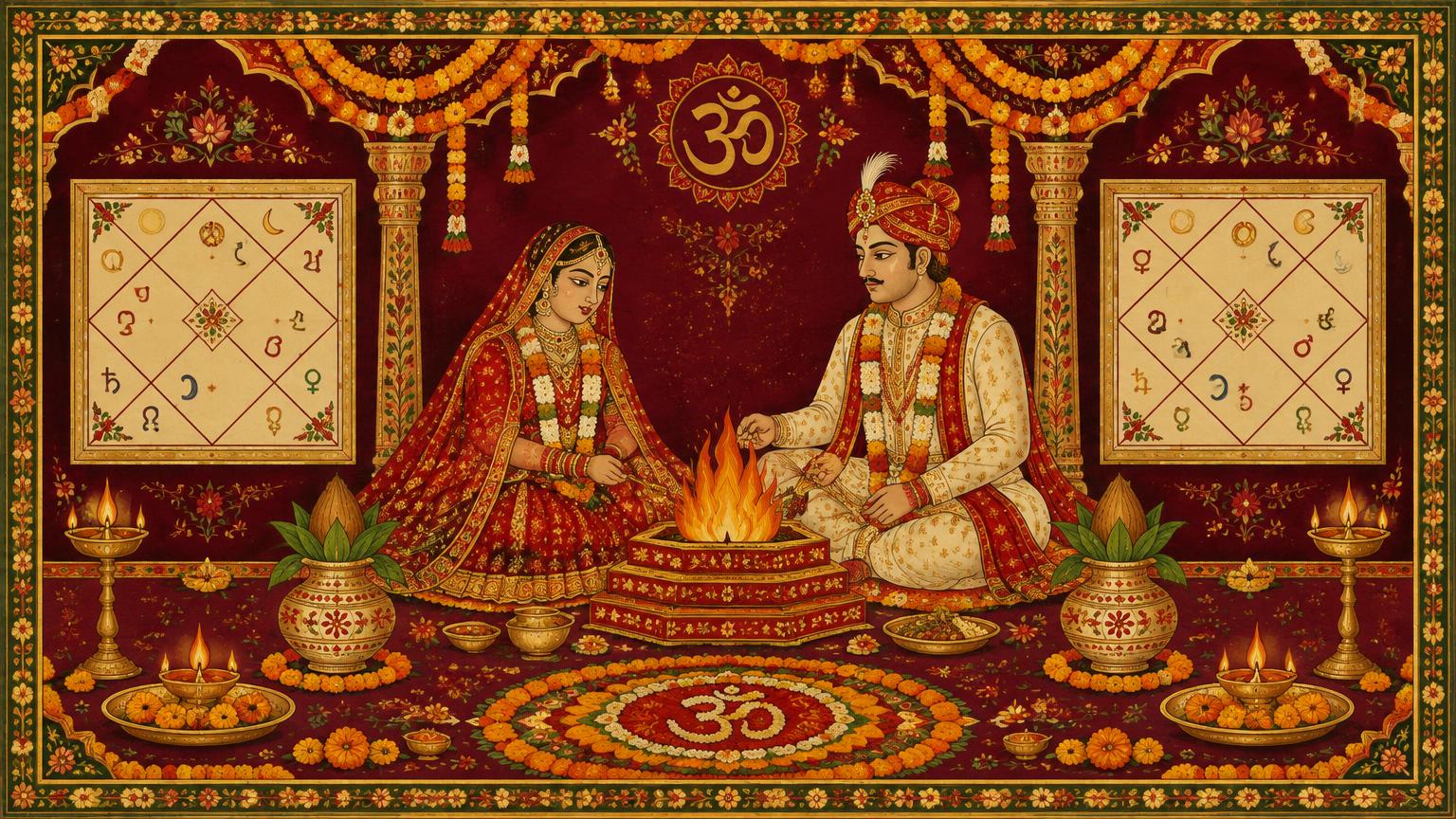
When couples or their families walk into my Noida practice carrying two birth charts, they often bring a mixture of hope and anxiety. Many have already run the charts through automated software, received a numeric score, and arrived with urgent questions about whether a specific point threshold or a feared planetary dosha seals their marital destiny.
Over the past two decades of practicing Vedic astrology, I have consistently reminded couples that a horoscope is not a verdict of doom, nor is it a magical guarantee of effortless romance. Kundli matching for marriage is a profound diagnostic framework designed by ancient rishis to understand how two temperaments, psychological blueprints, and life paths will interact across decades.
In this comprehensive 2026 guide, I will take you step-by-step through how an experienced astrologer actually examines chart compatibility. We will look past the surface-level point calculations, deconstruct common astrological doshas without unnecessary fear, explore meaningful chart indicators, and highlight the genuine astrological red flags that warrant careful attention before making a lifetime commitment.
Why does traditional kundli matching matter in 2026?
Modern relationships face unique pressures: dual-career demands, rapid lifestyle changes, evolving expectations of personal fulfillment, and high-stress environments. With so many variables in play, you might wonder why an ancient Vedic framework remains deeply relevant today.
The strength of classical Vedic astrology lies in its capacity to map unconscious behavioural patterns and emotional baselines. When two people marry, they do not just combine their conscious affections; they intertwine their emotional reactions, their financial habits, their health resilience, and their deepest spiritual values.
In my practice, I view horoscope matching not as a gatekeeper meant to deny happy unions, but as a roadmap of conscious awareness. If you know in advance where your partner seeks emotional security, how they process stress, and what mutual planetary cycles might test your shared patience, you can navigate life together with empathy instead of frustration.
Before diving into complex chart evaluations, you can generate both charts using our free kundli tool to observe the foundational placements of the Moon, Ascendant, and seventh house lords.
What is Guna Milan and how does the 36-point system work?
The most widely recognized component of traditional North Indian matchmaking is the Ashtakoot system, commonly called Guna Milan. This system allocates 36 points across eight distinct psychological and biological compatibility filters based primarily on the placement of the natal Moon in both charts.
Each of the eight Kootas addresses a specific dimension of relational harmony, ranging from instinctual reactions to deep biological synergy. The table below outlines how these 36 points are distributed and what each tier evaluates in real-world terms:
| Koota Name | Maximum Points | Core Dimension Evaluated | Practical Relationship Focus |
|---|---|---|---|
| Varna | 1 Point | Work temperament & ego drive | Mutual respect and ego compatibility in daily roles |
| Vashya | 2 Points | Mutual attraction & power balance | Natural emotional magnetism and balanced influence |
| Tara | 3 Points | Destiny & health compatibility | General well-being, auspiciousness, and mutual fortune |
| Yoni | 4 Points | Physical & biological harmony | Biological alignment, physical intimacy, and attraction |
| Graha Maitri | 5 Points | Psychological & mental rapport | Friendship, shared worldview, and everyday communication |
| Gana | 6 Points | Temperament & behavioural nature | Matching of spiritual, human, and assertive dispositions |
| Bhakoot | 7 Points | Emotional bonding & prosperity | Deep emotional resonance, family joy, and mutual growth |
| Nadi | 8 Points | Genetic energy & biological health | Longevity, vitality, and health of future progeny |
Traditionally, a score of 18 points out of 36 is considered the minimum acceptable threshold for guna milan in Vedic astrology, while scores above 24 are regarded as supportive. However, relying purely on this mathematical total is one of the biggest mistakes an individual or family can make.
Is a high Guna score alone enough to guarantee harmony?
The short answer is no. In my practice, I have reviewed many charts where couples scored 28 or even 32 Gunas, yet experienced significant emotional friction within the first few years of marriage. Conversely, I have seen enduring, harmonious marriages where the Ashtakoot score was barely 17 or 18 points.
Why does this happen? The Ashtakoot system measures only the relationship between the natal Moon positions of both individuals. While the Moon governs the emotional mind, perceptions, and immediate reactions, it represents only one facet of your total horoscope.
A complete compatibility analysis must evaluate:
- The strength and dignity of the 7th house (the primary house of partnership).
- The condition of Venus (the significator of love and harmony) and Jupiter (the significator of marital grace and wisdom).
- The Lagna (Ascendant) and Lagna Lord compatibility to ensure long-term life vision and personality synergy.
- The Navamsha (D9) divisional chart, which reveals the true inner strength of the marriage over time.
Treating Guna Milan as the sole metric is like buying a house based solely on the colour of the front door without inspecting the structural foundation. It is a helpful preliminary filter, but never the entire reading.
Which doshas actually matter in marital compatibility?
When families review compatibility reports, the word dosha often triggers immediate anxiety. A dosha simply translates to a flaw, imbalance, or area of friction in the planetary geometry. Most doshas come with classical exceptions, mitigating factors, and cancellations that generic online calculators completely overlook.
Let us look at the three major doshas encountered during Guna Milan:
1. Nadi Dosha
Carrying 8 points, Nadi is the heaviest weighted Koota. It classifies individuals into three physiological and energetic temperaments: Aadi (Vata/start), Madhya (Pitta/middle), and Antya (Kapha/end). When both partners share the same Nadi, Nadi Dosha is formed, traditionally indicating potential health imbalances or progeny challenges.
However, classical texts like the Muhurta Chintamani provide numerous cancellation rules. If the couple shares the same Moon sign but different Nakshatras, or shares the same Nakshatra but different Moon signs, or if their Nakshatra quarters (Padas) differ favorably, the dosha loses its malefic intensity.
2. Bhakoot Dosha
Bhakoot carries 7 points and occurs when the two Moon signs fall in specific geometric relationships: 2nd/12th (financial or health friction), 6th/8th (arguments and emotional distance), or 9th/5th (clashes over personal beliefs or creative direction).
Yet, if the planetary lords of both Moon signs are natural friends (such as the Sun and Jupiter, or Mercury and Venus), or if they share the exact same planetary ruler (such as Aries and Scorpio both ruled by Mars, or Taurus and Libra ruled by Venus), Bhakoot Dosha is largely neutralized.
3. Gana Dosha
Gana evaluates temperaments categorised as Deva (gentle, calm), Manushya (pragmatic, balanced), and Rakshasa (intense, fiercely independent). Friction traditionally arises when a Deva Gana matches with a Rakshasa Gana.
In practical application, Gana differences simply require an understanding of communication styles. A Rakshasa Gana native often communicates with directness and high intensity, while a Deva Gana native values diplomacy and peace. When both partners recognize this difference, it becomes a complementary balance of strengths rather than a point of conflict.
How do astrologers assess Manglik Dosha without fear?
Perhaps no concept in Vedic astrology has caused as much unnecessary dread as Manglik Dosha (also known as Kuja Dosha). It occurs when Mars is placed in the 1st, 2nd, 4th, 7th, 8th, or 12th house from the Ascendant, Moon, or Venus.
Mars represents drive, courage, assertiveness, and physical energy. When placed in houses related to domestic life and partnerships, its fiery nature can manifest as impatience, high expectations, or a sharp communication style. It does not mean a person is cursed, nor does it inherently threaten a partner's longevity.
In real chart analysis, true Manglik Dosha is far less common than people believe because classical exceptions almost always apply:
- Mars placed in its own signs (Aries or Scorpio) or exaltation sign (Capricorn) does not create harmful dosha.
- A strong, benefic Jupiter aspecting Mars softens its aggressive tendencies considerably.
- Mars positioned in the 2nd house in Gemini or Virgo, or in the 4th house in Aries, or in the 7th house in Cancer or Capricorn carries special classical exemptions.
- When both partners have Mars in similar houses or have strong Saturn/Sun placements balancing the energy, the fiery nature is naturally equalized.
In my practice, I focus on how Mars directs energy. A high-energy individual paired with someone who appreciates vitality and ambition can build a remarkably productive and dynamic life together.
What genuine astrological red flags should you watch for?
While point-based doshas are often overhyped, an experienced Vedic astrologer looks for deeper structural afflictions that indicate deep-seated relational challenges. Here are the genuine red flags I inspect during a Vedic marriage matching consultation:
- Severe Affliction to the 7th House and 7th Lord: If the 7th house in both charts contains deeply combust, debilitated, or severely afflicted malefics without any benefic aspect from Jupiter, Venus, or an unafflicted Mercury, the couple may struggle to maintain emotional peace.
- Mutual Planetary Enmity at the Ascendant Level: If the Lagna lords of both individuals are bitter enemies (for instance, the Sun and Saturn, or Mars and Mercury) and their Moons also sit in harsh angles, fundamental life outlooks and values will repeatedly collide.
- Severely Afflicted Venus (Shukra): Venus is the universal Karaka (significator) for love, respect, and mutual accommodation. When Venus is heavily afflicted by Rahu, Ketu, or Saturn in sensitive houses in both charts without relief, expressing affection and maintaining mutual trust requires conscious, hard work.
- Adverse 6th/8th Lagna Relationship: When one person's Ascendant is the 6th or 8th house relative to the other (for example, Leo Lagna and Pisces Lagna), unconscious misunderstandings regarding core responsibilities and priorities can become persistent.
- Unbalanced Malefic Density (Papasamyam): South Indian astrology places great importance on Papasamyam—ensuring that the weight of natural malefics (Mars, Saturn, Rahu, Ketu, Sun) in sensitive houses (1st, 2nd, 4th, 7th, 8th, 12th) is relatively equal in both charts. A massive imbalance can cause one partner to feel emotionally overwhelmed.
None of these factors mean marriage is impossible, but they do indicate that the union will require deliberate emotional maturity, clear boundaries, and honest communication.
How do the 7th house and Navamsha (D9) complete the picture?
The birth chart (Rasi D1) shows the general possibilities of life, but the Navamsha (D9 divisional chart) is the ultimate micro-lens for marriage. In Vedic tradition, the Rasi chart is the tree, while the Navamsha is the fruit that manifests in the second half of life.
When evaluating the Navamsha for compatibility, I look for several critical indicators:
- The Condition of the D9 Lagna and 7th House: A strong, well-placed D9 Ascendant lord indicates personal resilience and marital maturity. If the 7th house in the Navamsha receives benefic influences, it promises that shared joy will grow as the partners age.
- Vargottama Planets: When a planet occupies the exact same zodiac sign in both the Rasi and Navamsha charts, it gains exceptional strength (Vargottama). A Vargottama 7th lord or Venus provides remarkable stability to the union.
- Darakaraka Placement: In Jaimini astrology, the planet with the lowest degree in your chart (excluding Rahu/Ketu) is your Darakaraka, representing your spouse. Analyzing how each partner's Darakaraka interacts with the other's chart provides uncanny insight into personal compatibility.
If a Rasi chart shows minor flaws but the Navamsha is exceptionally dignified and supportive, the marriage will consistently overcome early hurdles and grow deeply fulfilling with time.
Can planetary dashas and transits override matching scores?
Even two horoscopes with perfect compatibility can experience rough patches if their individual planetary periods (Dashas) are out of alignment. Timing is the living engine of Vedic astrology.
Consider what happens during these specific dasha cycles:
- Dasha of the 6th or 8th Lord: If one partner enters the Mahadasha or Antardasha of their 6th lord (disputes, health challenges) or 8th lord (sudden changes, psychological turbulence), they may become withdrawn, irritable, or stressed by external events.
- Supportive 7th or 9th Lord Periods: When one or both partners run the dasha of benefic planets connected to the 7th, 5th, or 9th houses, domestic life experiences a natural period of warmth, ease, and shared celebration.
- Major Transits (Gochar): The movement of Saturn (Shani) and Jupiter (Guru) over natal planets creates windows of transformation. A challenging Saturn transit over the natal Moon (Sade Sati) or 7th house can bring heavy responsibilities that temporarily strain the relationship's emotional bandwidth.
Understanding the active dasha cycles allows an astrologer to tell a couple: "This upcoming two-year period is not about a failure of love; it is simply a phase of high external career pressure for one partner, requiring the other to hold steady space." That context alone can protect a marriage from unnecessary blame.
What practical remedies help balance minor chart friction?
Vedic remedies are not meant to magically alter a partner's personality or reverse core planetary geometries. Instead, they function as spiritual and psychological disciplines that refine your own internal energy, cultivate patience, and harmonise planetary vibrations.
Here are the traditional, grounded remedies I often recommend when minor chart imbalances appear:
- Strengthening Jupiter (Brihaspati): Jupiter represents divine grace, wisdom, and the willingness to compromise. Honoring Jupiter through regular contemplation, chanting the Brihaspati Gayatri Mantra, or supporting educational and charitable causes helps bring generosity into the household.
- Harmonising Venus (Shukra): Venus flourishes in an atmosphere of cleanliness, mutual appreciation, artistic beauty, and respect. Chanting the Shukra Beej mantra and cultivating genuine courtesy in daily speech strengthens weak Venusian energy.
- Pacifying Mars (Mangal): For charts with excess Martian heat, physical discipline, breathwork (Pranayama), and regular recitation of the Hanuman Chalisa provide an effective grounding channel for raw energy.
- Performing Grah Shanti Together: Pre-wedding pujas, Navagraha Shanti, and specific charitable acts performed mutually prior to marriage set an intentional, sacred foundation for shared life.
True astrological remedies always work hand-in-hand with self-awareness, active listening, and mutual respect.
Making an informed decision for your future
A marriage is one of the most significant spiritual and earthly journeys you will ever undertake. While modern digital algorithms can calculate points in seconds, they cannot weigh the context of your lives, the maturity of your minds, or the nuanced interplay of your divisional charts.
If you are currently evaluating a marriage proposal and wish to look beyond superficial point scores to understand the deeper emotional, spiritual, and planetary dynamics of your prospective union, I invite you to book a consultation for a comprehensive, confidential compatibility analysis.
Frequently asked questions
What is the minimum acceptable Guna score for marriage?
Traditionally, 18 out of 36 Gunas is considered the minimum baseline. However, a score between 18 and 24 can still yield an exceptionally harmonious marriage if the 7th house lords, Venus, Jupiter, and Navamsha (D9) charts are strong and supportive in both horoscopes.
Can two Manglik individuals marry each other safely?
Yes, in fact, classical Vedic astrology considers matching two Manglik individuals one of the best ways to balance Martian energy. When both partners possess a similar placement of Mars, their drive, energy levels, and assertiveness naturally mirror and neutralize each other.
What happens if Nadi Dosha is present in our match?
Nadi Dosha carries 8 points and indicates potential energetic or biological friction. However, classical texts outline dozens of cancellation rules based on shared planetary rulers, differing Nakshatra quarters (Padas), or distinct Moon signs that completely mitigate its adverse effects.
Is Guna Milan useful in modern arranged and self-chosen marriages?
Yes, Guna Milan remains a helpful preliminary lens for any marriage because it assesses psychological temperament, emotional reactions, and biological instincts. However, for self-chosen marriages, astrologers prioritize the 7th house strength, dasha timing, and Navamsha chart over raw numeric scores.
Can astrological remedies completely cancel all chart doshas?
Astrological remedies do not erase planetary placements; rather, they help balance energetic vibrations and cultivate personal awareness. Genuine remedies strengthen benefic planets like Jupiter and Venus, enabling couples to handle natural relationship challenges with greater wisdom, patience, and mutual respect.
Continue reading
The Complete Kundli Matching Checklist Before Saying Yes
A step-by-step Vedic astrology checklist covering Guna Milan, D9 Navamsa, Mangal Dosha, Dasha timing, and the vital houses before taking the marriage vows.
Every Marriage Dosha in One Place: A Reference Guide
A complete, clear reference guide to every major marriage dosha in Vedic astrology, including Manglik, Nadi, Bhakoot, and planetary combinations.
When Guna Score Was Low but the Marriage Worked
Discover why marriages with a low Guna score often thrive. Learn how Lagna strength, the Navamsa chart, and Dasha periods create lasting marital harmony.
Two Manglik Charts, One Peaceful Home: A Reading
Discover how two Manglik charts can create a balanced, thriving marriage through mutual planetary alignment, conscious communication, and classical Vedic insight.
New here? Start with the full guide to Doshas in Marriage Astrology, or try the free kundli tool.
Want your specific situation analysed?
Book a private Marriage & Relationship Consultation with Dr. Rahul Singh — your charts read in detail, with a clear, confidential opinion you can act on.
Limited offer · was ₹7,500 · 60-minute consultation + detailed written analysis