31 July 2026 · Daivagya
Guna Milan Explained: What Your 36-Point Score Really Means
Eighteen gunas, thirty-two gunas — what does the score actually measure? I explain the eight koots, how many gunas are required for marriage, and why the number alone should never decide a match.
Quick answer
Guna milan is a traditional Vedic compatibility system that scores eight emotional and physical factors based on the Moon's position. While eighteen points are typically required for approval, this score primarily reflects subconscious alignment rather than total marital success. A comprehensive analysis must also evaluate the seventh house, planetary strengths, and current time cycles to determine the true long-term viability of a union.
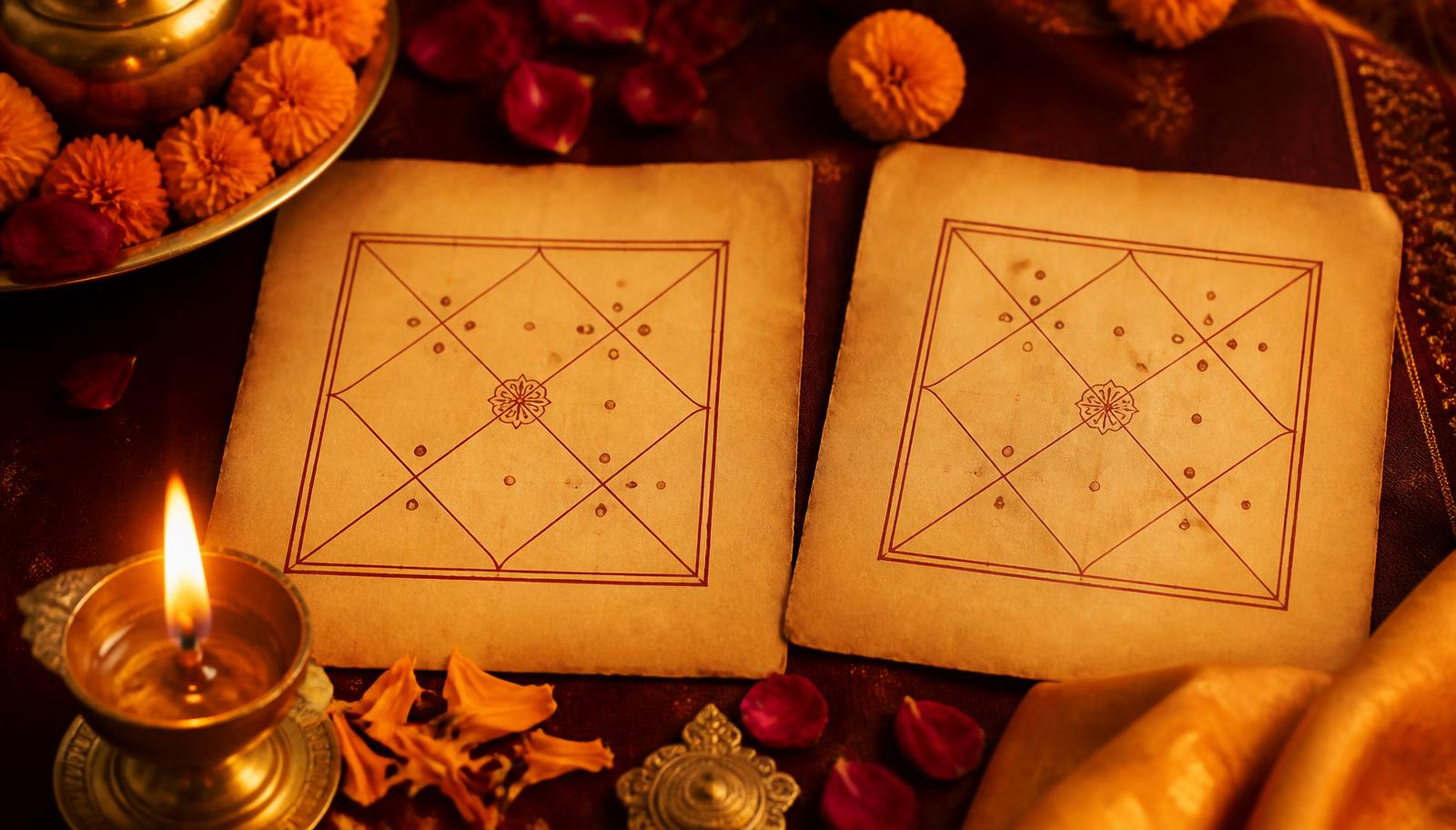
Every family that comes to me with a marriage proposal asks the same question in the end: "Sir, how many gunas are matching?" A number is quoted, a decision is almost made, and an entire life is weighed on a score of thirty-six.
In my practice I have seen beautiful marriages with modest scores and difficult marriages with very high ones. So let me explain what guna milan actually measures, and what it quietly leaves out.
What is guna milan in kundli matching?
Guna milan, also called Ashtakoot Milan, compares the Moon's nakshatra and rashi in two horoscopes across eight koots. Each koot carries its own weight, and together they add up to thirty-six points.
- Varna (1) — inner temperament and work orientation
- Vashya (2) — mutual influence and give-and-take
- Tara (3) — health and general well-being of the pair
- Yoni (4) — physical and instinctive compatibility
- Graha Maitri (5) — mental friendship, the meeting of minds
- Gana (6) — nature and disposition
- Bhakoot (7) — prosperity, family growth, emotional flow
- Nadi (8) — health of the couple and of children
Notice that Bhakoot and Nadi alone carry fifteen of the thirty-six points. That is why two charts can lose a large chunk of the score on a single factor.
How many gunas are required for marriage?
The traditional guidance is simple: eighteen and above is considered acceptable, twenty-four to thirty-two is considered very good, and above thirty-two is rare and excellent. Below eighteen, the classical texts advise caution.
But I always tell people this honestly — the number is a summary, not a verdict.
A score of thirty can still sit beside an afflicted 7th house, a weak Venus, or a Mars placement that makes tempers flare. A score of sixteen can belong to two people whose dashas support each other for the next twenty years. The points tell you about the Moon; marriage is lived by the whole chart.
Why a high score can still fail
Guna milan is based almost entirely on the Moon's position. It says a great deal about emotional wavelength and very little about the 7th house, the 8th house of longevity of the marriage, the strength of Venus and Jupiter, manglik dosha, or the timing of the running dasha.
I have often seen couples with excellent gunas struggle because their charts activated difficult periods at the same time — nothing in the thirty-six points would have warned them.
Equally, I have seen a low Bhakoot score in families who went on to live warmly together for decades, because the rest of both charts was strong and the intention was sincere.
How I read a match
When a proposal comes to me, guna milan is where I begin, never where I end. I look at the 7th house and its lord in both charts, the condition of Venus and Jupiter, Mars for temperament and dosha, the Navamsa chart for the deeper marital picture, and the dasha sequence for the coming years.
Only then do I say whether a match is supportive, workable with awareness, or genuinely unwise. And where something needs strengthening, I suggest remedies that are practical and honest — never fear, never a guarantee bought with money.
If a score has left your family uncertain, do not decide on that number alone. Bring both kundlis for a proper reading, and let us look at what the full charts are actually saying about your life together.
Continue reading
Every Marriage Dosha in One Place: A Reference Guide
A complete, clear reference guide to every major marriage dosha in Vedic astrology, including Manglik, Nadi, Bhakoot, and planetary combinations.
Two Manglik Charts, One Peaceful Home: A Reading
Discover how two Manglik charts can create a balanced, thriving marriage through mutual planetary alignment, conscious communication, and classical Vedic insight.
Manglik Dosha: The Complete Guide to Mangal Dosh, Its Real Effects and Working Remedies
Demystify Manglik Dosha with an honest Vedic astrology guide covering house placements, genuine marital effects, natural cancellations, and working remedies.
Kundli Matching for Marriage: A Complete 2026 Guide to Guna Milan, Doshas and Red Flags
Discover how Vedic astrology evaluates marriage compatibility beyond simple point scores, including Guna Milan, doshas, planetary alignments, and red flags.
New here? Start with the full guide to Kundli Matching: The Complete Guide, or try the free kundli tool.
Want your specific situation analysed?
Book a private Marriage & Relationship Consultation with Dr. Rahul Singh — your charts read in detail, with a clear, confidential opinion you can act on.
Limited offer · was ₹7,500 · 60-minute consultation + detailed written analysis