26 August 2026 · Daivagya
North Indian vs South Indian Chart Style: Reading Both
Understand the key difference between North Indian and South Indian kundli chart styles and learn to read both with confidence.
Quick answer
North Indian charts are diamond grids where houses stay fixed and signs move; South Indian charts are square grids where signs stay fixed and houses move. The calculations behind both are identical, so predictions never change with the chart style.
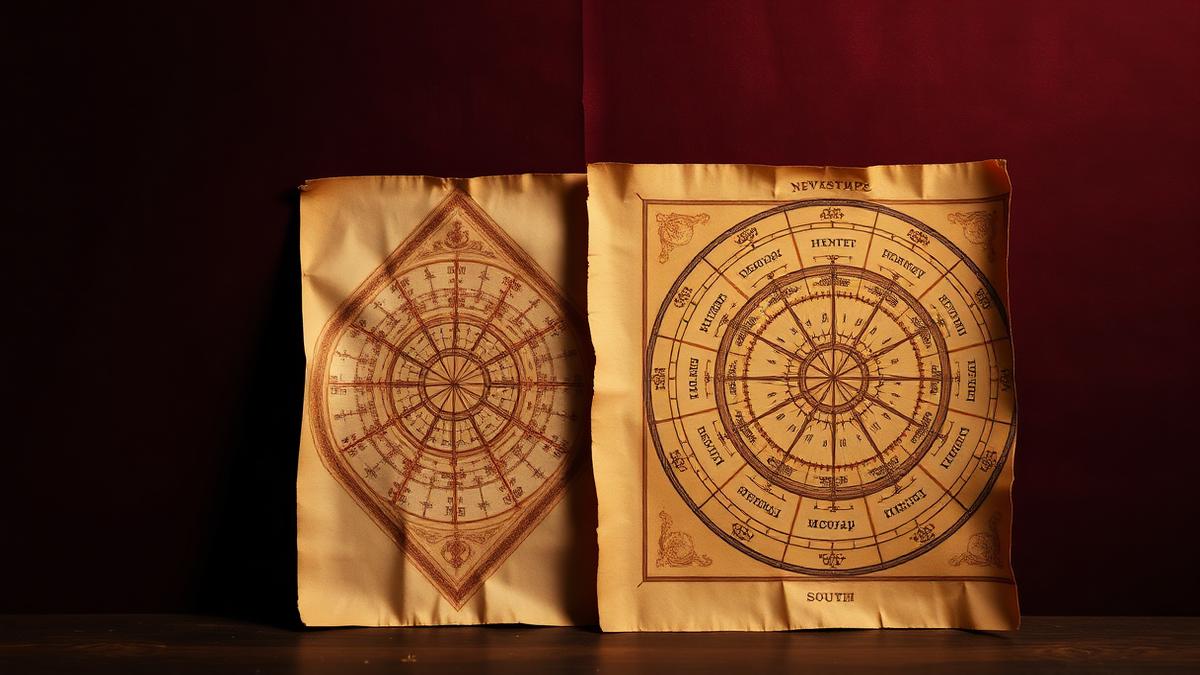
North Indian vs South Indian Chart Style: Reading Both
If you have ever compared two kundlis prepared in different formats, you may have wondered why they look so different even when describing the same birth. The information in both is identical, but the way it is drawn differs by regional convention. This post explains the two most common chart styles used in Vedic astrology and shows you how to read each one confidently.
Why Do Two Chart Styles Exist for the Same System?
Vedic astrology developed across different regions of India, and over centuries, distinct visual conventions emerged for drawing the same underlying calculations. The North Indian style is commonly used in Hindi-speaking regions, while the South Indian style is more common in Karnataka, Tamil Nadu, Andhra Pradesh and Kerala. Neither style changes the calculation of planetary positions; they only change how those positions are displayed on paper. When you generate a chart, you can usually choose either format depending on which one you find easier to read.
How Is the North Indian Chart Structured?
The North Indian chart is a diamond within a square, divided into twelve triangular and diamond-shaped compartments. In this format, the houses are fixed in position. The first house is always the diamond at the top centre, and the remaining houses follow in anticlockwise order around the chart.
What changes from person to person is which zodiac sign is written into each house. The sign number is marked inside each compartment, and this number shifts depending on your Lagna. So in a North Indian chart, you first locate the first house by its fixed position, then read the sign number written there to know your Lagna sign.
How Is the South Indian Chart Structured?
The South Indian chart is a square grid, usually of sixteen boxes with the four corner boxes left unused, giving twelve usable compartments. Here the logic is reversed compared to the North Indian style. The zodiac signs are fixed in position on the chart, always following the same clockwise order, with Aries typically placed in a set box regardless of whose chart it is.
What changes from person to person is which house number falls in which box, based on where the Lagna sign is located. So in a South Indian chart, you first find your Lagna sign in its fixed box, mark that as the first house, and then count the remaining houses clockwise from there.
What Is the Core Difference Between the Two?
The difference can be summarised simply: North Indian charts keep houses fixed and move the signs; South Indian charts keep signs fixed and move the houses. This single distinction is the key to reading both formats without confusion.
| Feature | North Indian Style | South Indian Style |
|---|---|---|
| Shape | Diamond within a square | Square grid |
| Fixed element | House positions | Sign positions |
| Variable element | Sign written in each house | House number in each box |
| First house | Always the top diamond | Wherever the Lagna sign box is |
| Common regions | North India | South India |
How Do You Read a Planet's House Placement in Each Style?
In a North Indian chart, you first identify the Lagna sign in the fixed first house, then look at where each planet's sign appears among the twelve compartments to know which house it falls in.
In a South Indian chart, you first locate the Lagna sign among the fixed boxes and label it as the first house, then count forward through the fixed sign sequence to label all other houses. Once houses are labelled, you check which box each planet's sign falls in to know its house placement.
Both methods lead to the same houses and the same interpretation. The reading of yogas, Dasha periods and house significations does not change with the chart style; only the visual method of locating information changes.
Which Style Should a Beginner Learn First?
There is no astrological advantage of one style over the other. It largely comes down to personal comfort and regional familiarity. If you grew up around North Indian charts, that layout will likely feel intuitive at first. If South Indian charts are more familiar to you, start there. Many practising astrologers eventually learn to read both fluently, since clients across India bring charts in either format for consultation.
Are There Other Regional Styles Besides These Two?
Yes, there is also an Eastern Indian or Bengali style, which resembles the North Indian diamond format but with some structural differences, and it is less commonly seen outside eastern India. For most practical purposes, learning North Indian and South Indian styles covers the vast majority of charts you will encounter.
Does the Chart Style Affect Astrological Predictions?
No. The chart style is purely a presentation convention. The underlying planetary positions, house lords, Dasha calculations and yogas are computed identically regardless of which visual format is used. If a marriage-related reading, career analysis or any other prediction differs between two practitioners, the difference lies in interpretation methodology, not in the chart style used. For a detailed reading of your own chart in either format, you can book a consultation.
FAQ
Q1: Will my predictions change if I switch from a North Indian chart to a South Indian chart? No, the predictions remain the same because both formats represent identical planetary calculations. Only the visual layout used to display houses and signs differs between the two styles.
Q2: Which chart style is more traditional or accurate? Neither style is more accurate than the other. Both are regional conventions for displaying the same Vedic calculations, and the choice is a matter of familiarity rather than precision.
Q3: Can I generate both chart styles for the same birth details? Yes, most kundli tools allow you to view your chart in either North Indian or South Indian format using the same birth date, time and place.
Continue reading
Combust Planets: When a Planet Loses Its Voice
Combust planets sit too close to the Sun and struggle to express themselves. Learn what combustion means for marriage and life outcomes.
Retrograde Planets in a Birth Chart and What They Change
Retrograde planets in a birth chart do not mean weakness. Learn what they actually change in timing, temperament and marriage matters.
How to Read Your Own Kundli: A Beginner's Five-Step Method
Learn a simple five-step method to read your own kundli correctly, from Lagna to Dasha, without misinterpreting isolated placements.
Your First Consultation: What to Expect, Step by Step
Wondering what happens during your first Vedic astrology reading? Here is a transparent, step-by-step walkthrough of the consultation process and how to prepare.
Want your specific situation analysed?
Book a private Marriage & Relationship Consultation with Dr. Rahul Singh — your charts read in detail, with a clear, confidential opinion you can act on.
Limited offer · was ₹7,500 · 60-minute consultation + detailed written analysis