14 October 2026 · Daivagya
Ahoi Ashtami 2026 (1 November): The Kartik Vrat Families Keep for Children and Family Peace
Discover the significance, timings, and astrological remedies of Ahoi Ashtami 2026 on 1 November for your children's well-being and lasting family peace.
Quick answer
Ahoi Ashtami falls on Sunday, 1 November 2026, during the auspicious month of Kartik. Observed on Krishna Paksha Ashtami, this sacred fast honors Ahoi Mata to bless children with longevity, good health, and academic focus while restoring peace within the household. Performing the evening starlight puja strengthens the astrological 5th house and Jupiter energies.
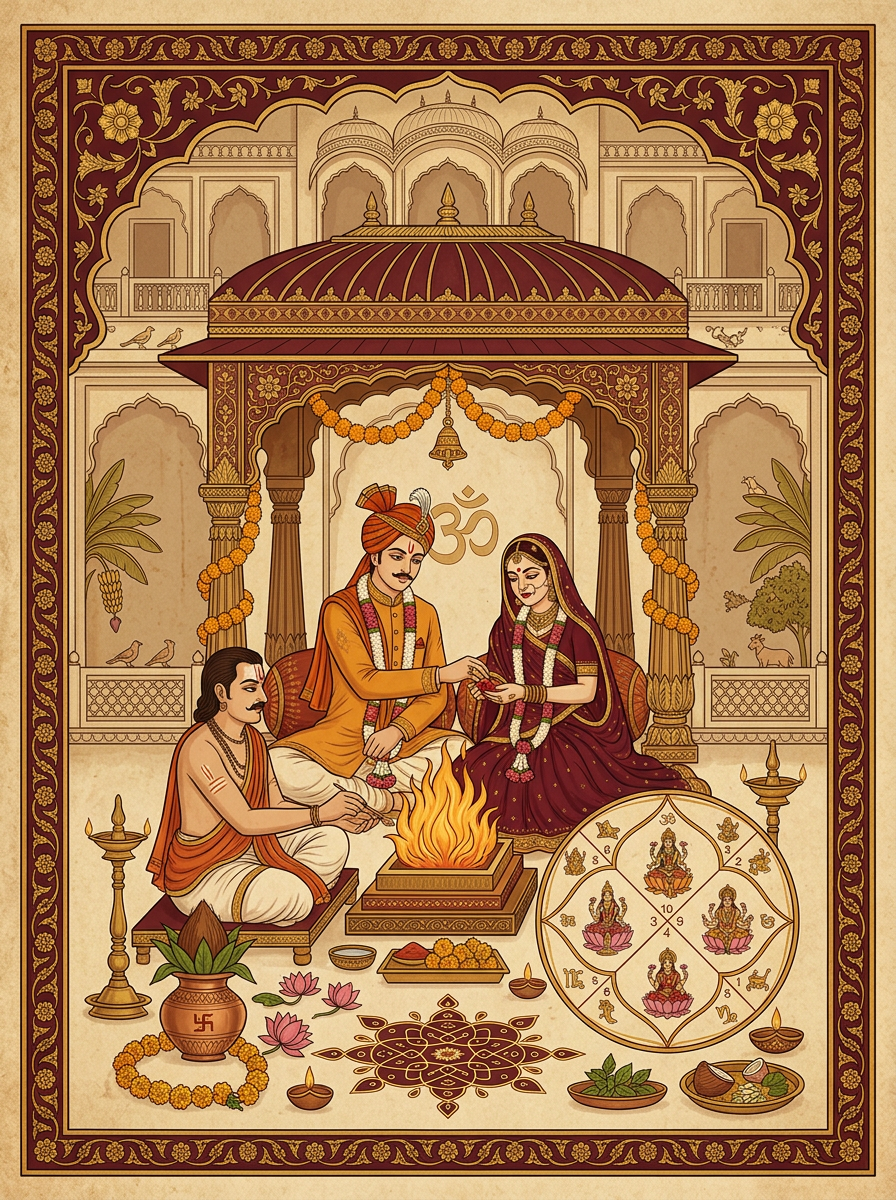
Every autumn, right in the heart of the festive Kartik month, there comes an evening when the courtyard grows quiet, women gather with sacred silver beads, and eyes turn toward the twilight sky waiting for the first stars to emerge. This is Ahoi Ashtami, an ancient and deeply loved ritual observed across Northern and Western India.
In my astrology practice in Noida, I often meet parents who carry deep concerns about their children—whether about their health, emotional balance, academic progress, or family discord. While planetary charts offer diagnostic clarity, traditional fasts like Ahoi Ashtami 2026 provide an intentional, devotional space to realign household energies. Falling on Sunday, 1 November 2026, this sacred observance invites families to come together and pray for the longevity, protection, and prosperity of their lineage.
What makes Ahoi Ashtami 2026 particularly special?
In the Vedic calendar, the lunar month of Kartik holds a revered status. Every ritual performed during Kartik is believed to yield amplified spiritual fruit because planetary transits during this period naturally favor inward reflection and austerity.
On 1 November 2026, the Ashtami tithi of Kartik Krishna Paksha brings a powerful confluence of planetary alignments. The Moon navigates nakshatras that accentuate emotional resilience and maternal instinct. When a family fasts with pure intent on this day, it directly harmonizes the lunar energy in the home, softening friction and creating a protective shield around the younger generation.
In our shastras, this day is dedicated to Goddess Ahoi, an incarnation of cosmic maternal energy often linked with Goddess Parvati. She protects the young from unseen afflictions, removes negative planetary currents affecting early life, and restores warmth between generations.
Why is Ahoi Ashtami observed for children and domestic peace?
The central legend of Ahoi Ashtami speaks to every parent's deepest instinct: the desire to protect one's offspring from harm and repair unintended mistakes.
According to traditional lore, a devoted woman accidentally injured animal offspring while digging soil for pre-Diwali repairs. Overcome with grief and subsequent family struggles, she undertook severe penance, fasting on Kartik Krishna Ashtami and praying to Goddess Ahoi. Moved by her sincere repentance and devotion, the Goddess restored joy, health, and peace to her family.
From an astrological perspective, this vrat addresses two vital dimensions of domestic life:
- Santan Raksha and Santan Sukh: Shielding children from malefic planetary transits, evil eye (buri nazar), and emotional instability.
- Griha Shanti: Diffusing unresolved stress within the household and nurturing mutual respect between spouses as they care for their shared lineage.
When you observe the Ahoi Mata vrat, you are not just following an inherited tradition; you are consciously sending positive psychic intentions into your home's energetic atmosphere.
How does Vedic astrology view the link between fasting and the 5th house?
In personal horoscopes, matters concerning children, intelligence, creativity, and past-life merits (Purva Punya) are ruled primarily by the 5th house. The primary planetary karaka (significator) for progeny and children's welfare is Jupiter (Guru), while the Moon (Chandra) governs maternal nurture and emotional stability.
| House / Planet | Astrological Role in Child Well-being | How Ahoi Ashtami Helps |
|---|---|---|
| 5th House (Santan Bhava) | Governs conception, progeny, intelligence, and moral character. | Purifies negative afflictions through voluntary austerity and mantra japa. |
| Jupiter (Guru) | The natural significator for children, wisdom, and lineage expansion. | Strengthens benevolence and protects children against academic or directional confusion. |
| Moon (Chandra) | Rules motherhood, emotional peace, mental health, and family bonding. | Water arghya given to stars/moon calms erratic lunar energies in the household. |
| Saptamsha (D7 Chart) | The divisional chart analyzed specifically for child welfare and lineage dynamics. | Ritualistic prayer generates subtle positive karmic points that support D7 placements. |
If you have ever checked your birth chart using our free kundli tool, you might have noticed how planetary aspects onto your 5th house shape your parenting journey. When malefic planets like Rahu, Ketu, or Saturn cast a shadow on the 5th house or Jupiter, parents often experience undue anxiety regarding their children. Fasting on Ahoi Ashtami acts as an active, conscious remedy to pacify these heavy planetary currents.
What are the key muhurats and timings for Ahoi Ashtami on 1 November 2026?
Precision in timing enhances the energetic efficacy of any Vedic ceremony. Because Ahoi Ashtami involves fasting through the day and concluding the worship upon sighting the evening stars (or the Moon), knowing the auspicious windows is essential.
Here are the calculated astronomical windows for New Delhi / NCR and central North India on Sunday, 1 November 2026:
- Ashtami Tithi Begins: Early morning hours of 1 November 2026
- Ashtami Tithi Ends: Morning hours of 2 November 2026
- Ahoi Ashtami Puja Muhurat: 05:35 PM to 06:54 PM (approximate evening window)
- Sanjh Tare (Star Sighting) Time: Around 06:12 PM
- Moonrise Timing on Ahoi Ashtami: Around 11:28 PM
Most families conclude their fast after offering Arghya (water offering) to the twinkling stars during twilight. However, those observing special vows for child conception or intense remedies often wait until the late-night moonrise to conclude their prayer.
How should you perform the Ahoi Mata puja step by step?
The beauty of Ahoi Ashtami lies in its traditional simplicity. You do not need elaborate or expensive paraphernalia; pure devotion and correct intent are what truly matter.
1. Morning Sankalp
Wake up before sunrise, take a purifying bath, and resolve to observe a waterless fast (Nirjala Vrat) or a fruit-based fast (Phalahar), depending on your health capacity. State your name, gotra, and your heartfelt wish for the well-being and long life of your children.
2. Preparing the Sacred Altar
In the North-East or East corner of your home, cleanse the wall or place a clean wooden chowki (patta). Traditionally, an image of Ahoi Mata with eight corners (Ashtakosh), along with illustrations of the lion cub, seven sons, and auspicious symbols like the Swastika, is drawn using geru (ochre) or placed via a printed photo.
3. The Karwa and Syau Garland
Place an earthen pot (karwa) filled with clean water, adorned with moli (sacred thread) and a swastika made with roli. Many mothers use a special silver pendant known as Syau Mala (Ahoi Syau). On every Ahoi Ashtami, two new silver beads are added to this thread, representing the growing years and protection of their children.
4. Offerings and Katha
Offerings typically include:
- Boiled sweet wheat dumplings (pua), roasted grains, or halwa puri
- Fresh seasonal fruits (especially water chestnuts / singhara and sugarcane)
- Roli, akshat (unbroken rice), fresh flowers, and dhoop
Sit together as a family to read or listen to the Ahoi Ashtami Vrat Katha. Holding grains of wheat or rice in your fist while listening to the story is a time-tested custom.
5. Arghya to the Evening Stars
Once the evening stars become clearly visible in the sky, step into an open balcony, terrace, or courtyard. Pour water from your brass lota toward the stars while praying for your children's radiant future. Distribute the prasad to your children first, take blessings from the household elders, and then break your fast.
What planetary combinations indicate a need for Santan-related remedies?
In my consultations, I often evaluate whether specific parental fasts and planetary remedies are advisable. While every parent can observe Ahoi Ashtami for general goodwill, it is especially transformative for families experiencing distinct astrological patterns.
Some of these classic chart indicators include:
- Afflicted 5th Lord: When the planet ruling the 5th house is placed in the 6th, 8th, or 12th house, creating hurdles in early education or temperamental clashes with children.
- Jupiter under Rahu/Ketu Aspect: Also known as Guru Chandal influences or karmic nodes afflicting the planet of lineage, leading to anxiety regarding a child's future.
- Pitra Dosha or Kuldevta Neglect: Gaps in honoring ancestral traditions that sometimes manifest as continuous domestic friction or repetitive obstacles for young children.
- Weak Moon in Lagna or 4th House: Creating a household climate of emotional restlessness, impatience, and frequent minor arguments between parents and kids.
When a mother or father performs Santan Prapti remedies and observes the Ahoi fast with steady focus, it mitigates the heat of these difficult alignments, inviting divine grace into the domestic sphere.
How does Ahoi Ashtami foster harmony between married couples?
Though Ahoi Ashtami is popularly described as a mother's fast for her children, its deeper psychological and astrological impact extends directly to the marital bond.
Raising children brings profound joy, but it also introduces real-world stress—financial planning, differences in parenting philosophies, and demanding schedules. Over time, these pressures can create subtle distance between husband and wife.
When both partners come together to support this sacred ritual—where one fasts, the other assists with preparations, and both stand before the deity praying for their children—it re-establishes a powerful sense of shared purpose. In astrology, when parents unite in devotion for their lineage, it simultaneously strengthens the 7th house (partnership) and the 9th house (dharma and fortune).
If your household has felt chaotic or emotionally strained recently, taking this day to step back from screens, prepare prasad together, and seek blessings can quietly reset the energy of your entire home.
What traditional practices should you keep in mind during the fast?
To preserve the spiritual integrity of Ahoi Ashtami, certain time-honored guidelines are recommended in our Vedic tradition:
- Avoid sharp tools: On this day, traditional custom advises fasting women to refrain from using scissors, needles, or knives, honoring the legend of not causing harm to any living creature.
- Maintain peaceful speech: Avoid anger, harsh words, or scolding children on the day of the fast. The fast is as much an exercise in speech purification (Vaak Shuddhi) as it is in dietary restraint.
- Involve your children: Let your children participate in simple tasks—lighting the diya, offering flowers, or serving elders. This plants seeds of cultural awareness and filial respect early on.
- Charity to the needy: Donating warm clothes, milk sweets, or educational materials to underprivileged children on Kartik Krishna Ashtami brings immense positive merit (Punya).
If you find yourself navigating complex planetary cycles or seeking clear, personalized insights into your family's astrological blueprint, you can always book a consultation to explore your charts with depth and empathy.
Summary of Ahoi Ashtami Ritual Sequence
To make your observance smooth and fulfilling on Sunday, 1 November 2026, keep this handy flow in mind:
- Pratah Kaal (Morning): Snan, Sankalp, and setting up the clean puja altar.
- Madhyahna (Afternoon): Maintaining inner calmness and preparing sattvic prasad.
- Sayankaal (Evening Muhurat - 5:35 PM to 6:54 PM): Lighting the ghee lamp, performing Ahoi Mata puja, and reciting the Vrat Katha.
- Tara Darshan (Twilight - ~6:12 PM): Offering Arghya to the stars with pure water and unbroken rice.
- Parana (Post-Puja): Touching elders' feet, giving sweets to children, and breaking the fast.
Frequently asked questions
Can both mothers and fathers observe the Ahoi Ashtami fast?
Yes, absolutely. While tradition has seen mothers lead the fast, fathers can certainly observe the vrat or actively participate in the puja rituals. When both parents unite with genuine devotion for their children's well-being and moral guidance, the positive energetic impact on the household is profoundly strengthened.
What if the stars are not visible due to cloudy weather or pollution?
If the stars are obscured by heavy cloud cover or smog on the evening of 1 November 2026, you do not need to worry. You may offer Arghya and conclude your worship at the predetermined astrological star-sighting time (around 06:12 PM), keeping your focus entirely on sincere prayer.
Can couples hoping to conceive observe the Ahoi Ashtami vrat?
Yes. Couples seeking the blessing of children (Santan Prapti) often observe this fast together. They offer prayers to Goddess Ahoi and Lord Shiva-Parvati, placing a silver bead or pairing the fast with prayers to the Moon at night to invoke divine blessings for lineage continuation.
How is the Syau Mala worn and preserved across generations?
After the evening puja, the silver Syau pendant and beads are worn by the mother until Diwali or Kartik Purnima, after which the garland is safely preserved in the home altar. Each year on Ahoi Ashtami, it is brought out, purified with raw milk and water, and blessed again.
What should be done with the water kept in the Karwa after puja?
Do not discard the water from the Karwa. On the morning after Ahoi Ashtami, sprinkle some of this sacred water across all rooms of your home for energetic purification and peace, and pour the rest at the root of a sacred Tulsi plant or flowering tree.
Continue reading
Karwa Chauth 2026 (29 October): The Astrology Behind the Vrat and What It Means for Your Marriage
Discover the deep astrological significance of Karwa Chauth 2026 on 29 October, the cosmic influence of the Moon, and how this sacred fast supports marriage.
Diet and Planetary Balance: An Ayurvedic-Astrological View
Discover how Vedic astrology and Ayurveda unite to balance planetary energies, nourish digestion, and cultivate vitality through conscious, elemental eating.
Mental Peace After Marriage: Remedies That Genuinely Help
Discover practical, time-tested Vedic remedies to restore emotional calm, balance planetary friction, and cultivate lasting mental peace after marriage.
Navratri 2026 Remedies for Those Seeking a Life Partner (11-20 October)
Discover authentic Vedic remedies during Sharad Navratri 2026 (11-20 October) to remove marriage delays, balance key planetary energies, and attract a life partner.
Want your specific situation analysed?
Book a private Marriage & Relationship Consultation with Dr. Rahul Singh — your charts read in detail, with a clear, confidential opinion you can act on.
Limited offer · was ₹7,500 · 60-minute consultation + detailed written analysis