23 August 2026 · Daivagya
What Parents Should Check Before Approving a Marriage Proposal
Before approving a marriage proposal, parents should verify specific chart factors, not just the guna score. Here is a practical checklist.
Quick answer
Before approving a proposal, parents should check the 7th house strength, Venus and Mars condition, any doshas and their remedies, the Navamsa chart, and the dasha periods of both individuals rather than relying on the guna score alone. A proper marriage proposal analysis brings all these factors together in one clear assessment.
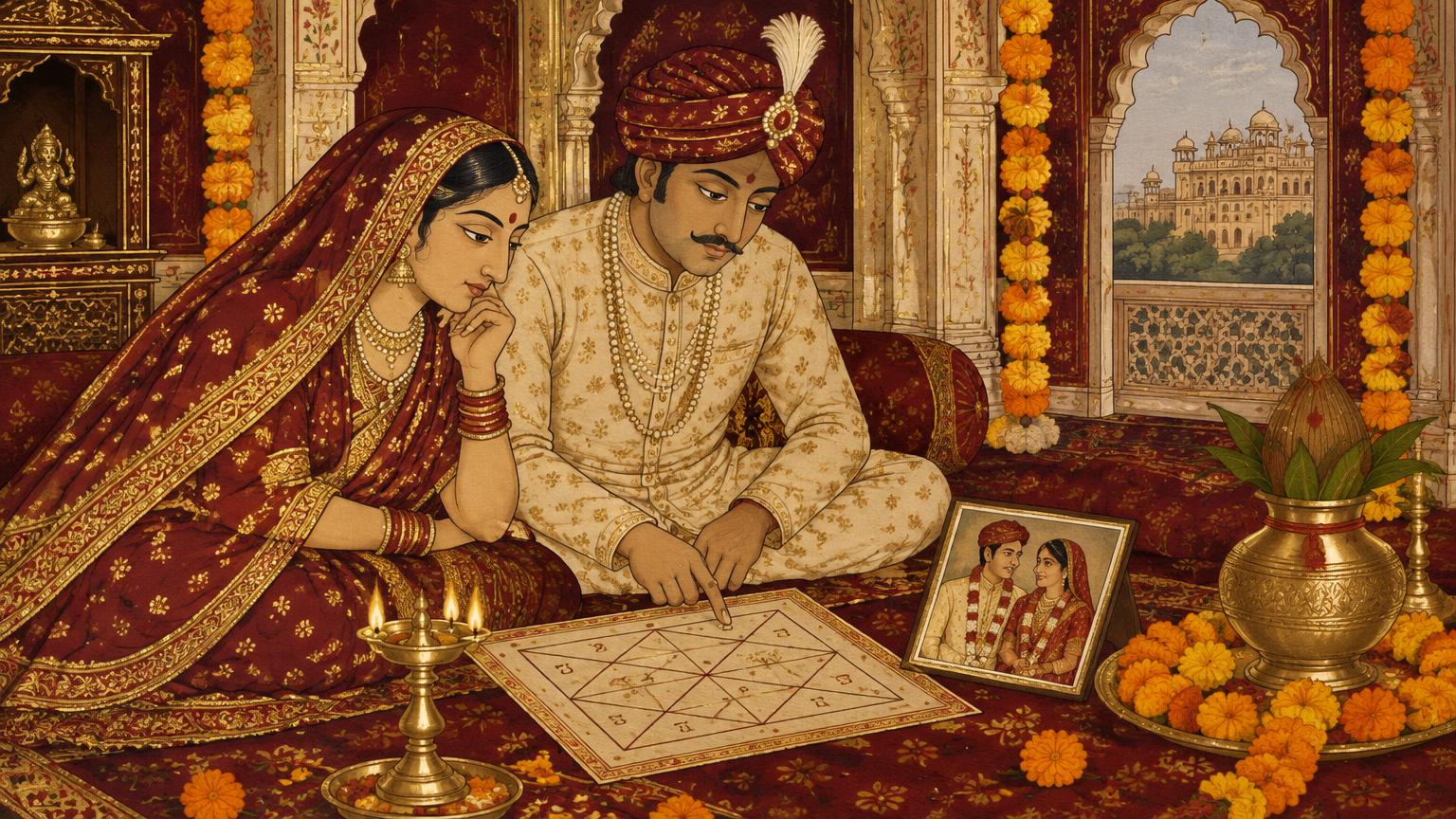
Before approving a marriage proposal, parents should look well beyond the familiar 36-guna matching score. A genuinely useful evaluation checks the strength of the 7th house, the condition of Venus and Mars, the presence of any doshas along with their remedies, the Navamsa chart, and the dasha periods both individuals are likely to experience in the early years of marriage. This article sets out a practical, structured checklist for parents evaluating a proposal.
Is the guna score enough to approve or reject a proposal?
No, the guna score is only a starting point. It gives a broad numerical indication of compatibility across eight defined factors, but it does not capture the finer detail found in the 7th house, Venus, Mars, or the Navamsa chart. Parents who rely on the guna score alone risk either rejecting a genuinely compatible match over a modest score, or approving a proposal that has a deeper, unaddressed concern the score does not reveal. A proper kundli matching process should always go further.
What should parents specifically ask the astrologer to check?
- 7th house and 7th lord: Ask whether the 7th house is well placed and whether its lord is strong, since this house governs the overall nature of married life.
- Venus and Mars: Ask about the condition of Venus (affection and harmony) and Mars (energy and temperament) in both charts, and whether they support each other or create friction.
- Doshas and their remedies: Ask specifically whether Manglik dosha, Nadi dosha, or Kaal Sarp dosha is present, and — just as importantly — what the established remedial options are. A dosha should prompt a conversation about remedies, not an automatic rejection.
- Navamsa (D-9) chart: Ask for a comparison of the Navamsa charts, since this often reveals compatibility depth not visible in the main birth chart.
- Dasha timing: Ask what dasha periods both individuals will be running through around the time of marriage, since this affects how smoothly the early years are likely to unfold.
What is a practical checklist for parents before approving a proposal?
- Confirm accurate birth details (date, time, place) for both individuals — an inaccurate birth time undermines the whole analysis.
- Request a full guna matching along with a written explanation of any unmatched gunas, not just the total score.
- Ask for a specific assessment of the 7th house, Venus, and Mars in both charts.
- Ask whether any dosha is present, and if so, request the specific remedial recommendation.
- Ask for a Navamsa chart comparison as part of the kundli review.
- Ask about the dasha periods of both individuals for at least the first few years of marriage.
- Only after all the above is discuss, consider the family and personal factors alongside the astrological picture.
- If proceeding, plan the wedding muhurat with the same level of care.
How should parents weigh a dosha finding?
A dosha finding should be treated as useful information rather than a verdict. The table below summarises common doshas and a balanced way to think about each.
| Dosha | What It Indicates | Balanced Approach |
|---|---|---|
| Manglik Dosha | Potential friction, assertiveness in the relationship | Match with another Manglik chart, or apply standard remedial measures |
| Nadi Dosha | Concern related to health and progeny compatibility | Verify carefully; remedies exist and full rejection is often unnecessary |
| Kaal Sarp Dosha | General life obstacles, not marriage-specific alone | Assess overall chart strength before treating it as decisive |
| Gana Dosha | Difference in basic temperament/nature | Usually manageable with mutual understanding and minor remedial steps |
Should parents rely on a single astrologer's opinion or seek a second reading?
For a decision as significant as marriage, a second, more detailed reading is a reasonable step if the first opinion feels incomplete or is based only on a guna score. A proper marriage proposal analysis that documents each factor — 7th house, Venus, Mars, doshas, Navamsa, and dasha timing — gives parents a clear written basis for the family's discussion, rather than a verbal impression that is hard to revisit later.
What role does timing play in the decision itself?
Beyond the compatibility of the two charts, it is worth checking whether the proposed timeframe for marriage aligns with a favourable period for both individuals. A proposal can be astrologically sound in terms of compatibility, yet the family may still benefit from choosing the wedding date carefully based on marriage timing principles, so that the union begins during a supportive planetary period rather than a difficult one.
What should parents avoid doing during this process?
- Avoid rejecting a proposal solely on a modest guna score without a fuller reading.
- Avoid treating any single dosha as an automatic disqualifier without understanding its remedy.
- Avoid skipping the Navamsa and dasha review, since these often carry as much weight as the main chart.
- Avoid rushing the decision without accurate birth details for both sides.
- Avoid using astrology as the only basis for decision-making — it should complement, not replace, the personal and family conversations that matter equally.
What is the most balanced way to reach a decision?
The most balanced approach combines a full, factor-by-factor astrological review with ordinary personal and family judgment — meeting the other family, understanding shared values and expectations, and gauging the compatibility between the two individuals directly. The chart analysis narrows down specific areas of strength or concern; the family conversation and personal interaction fill in the rest.
Where should parents go for a thorough proposal review?
A comprehensive marriage compatibility analysis or dedicated marriage proposal analysis brings together guna matching, the 7th house and its lord, Venus and Mars, relevant doshas with their remedies, Navamsa comparison, and dasha timing into a single, clear assessment. Parents evaluating a proposal are encouraged to book a proper consultation so that the family's decision rests on a complete picture rather than a partial one.
In short, approving a marriage proposal deserves more than a glance at the guna score. A structured review of the 7th house, Venus, Mars, doshas, Navamsa chart, and dasha timing gives parents the clarity needed to make a confident, well-informed decision for their family.
How should parents handle disagreement between two different astrologers' opinions?
It is not unusual for two astrologers to emphasise different aspects of the same chart, particularly if one relies mainly on the guna score while the other conducts a fuller review including the 7th house, Navamsa, and dasha timing. In such cases, parents should ask both astrologers to explain the specific factors behind their conclusions rather than simply comparing final verdicts. A reading that clearly documents each factor — with reasoning — is generally more useful for family decision-making than one that offers only a summary opinion.
What should parents check beyond the chart itself?
While the astrological review is valuable, parents should also weigh it alongside ordinary considerations: the compatibility of values and expectations between the two individuals, the willingness of both families to communicate openly, and the general life circumstances of the prospective match. Astrology works best as one well-informed input among several, helping to highlight where extra care or remedial attention may be needed, rather than functioning as the sole basis for the decision.
Why is documentation of the reading useful for the family?
A written, factor-by-factor report — covering the guna score, 7th house and lord, Venus and Mars, doshas and remedies, Navamsa comparison, and dasha timing — gives the family something concrete to revisit and discuss together, rather than relying on memory of a verbal conversation. This is particularly useful when multiple family members are involved in the decision and want to review the same information independently before the proposal is finalised.
Continue reading
Long-Distance Marriage: Charts That Handle It Well
Which chart placements help a marriage stay strong even when partners live apart for work or family reasons.
Meeting a Match Online: How Your Chart Helps You Choose Wisely
How to use birth chart analysis to bring clarity and caution when you are evaluating a match you met online.
Marrying Later in Life: What Matching Should Focus On
Why chart matching for a later-life marriage should focus less on rigid gun scores and more on maturity, dashas and real compatibility.
How to Know Whether a Marriage Proposal Is Astrologically Compatible
A structured, chart-based approach to evaluating a marriage proposal beyond guna milan scores alone.
New here? Start with the full guide to Kundli Matching: The Complete Guide, or try the free kundli tool.
Want your specific situation analysed?
Book a private Marriage & Relationship Consultation with Dr. Rahul Singh — your charts read in detail, with a clear, confidential opinion you can act on.
Limited offer · was ₹7,500 · 60-minute consultation + detailed written analysis