28 August 2026 · Daivagya
Varshphal (Annual Chart) and Predicting the Year Ahead
Discover how the Varshphal (solar return chart) pinpoints key themes, opportunities, and milestones for your upcoming year in Vedic Tajik astrology.
Quick answer
A Varshphal is an annual Vedic horoscope cast for the exact moment the Sun returns to its natal position each year. While the birth chart outlines your lifelong destiny and Dashas reveal broad life chapters, the Varshphal acts as a high-resolution lens, identifying specific themes, challenges, and relationship opportunities over a single 12-month period.
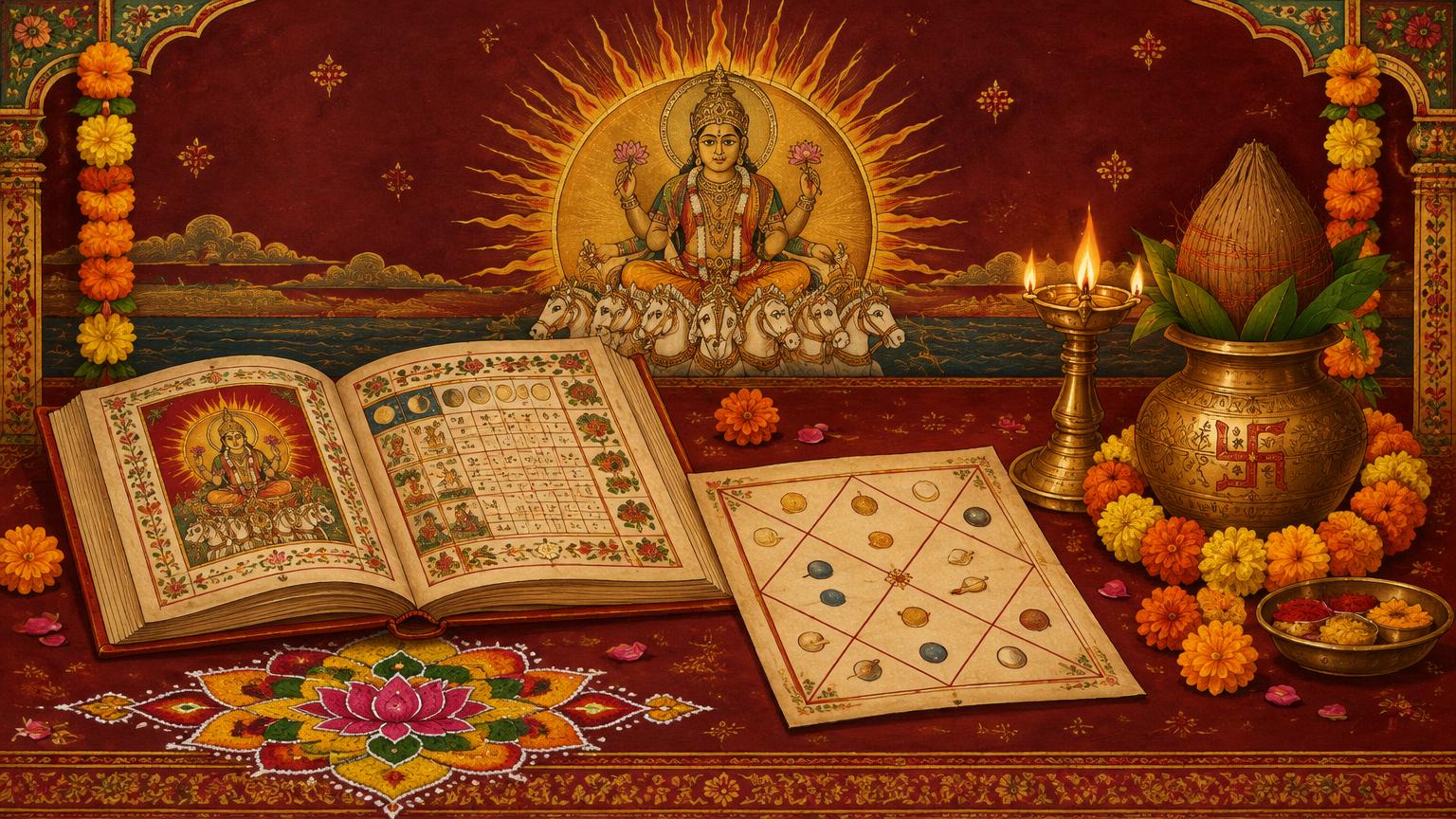
Every year around your birthday, a quiet astrological reset takes place. In Vedic astrology, this milestone is marked not merely by the calendar date, but by the exact solar return—the precise moment the transiting Sun returns to the exact degree, minute, and second it occupied at your birth. The chart cast for this exact moment is known as the Varshphal annual chart.
In my practice at Daivagya, I often meet people who feel that their broad Mahadasha periods explain their life's general weather, but fail to explain why a specific year felt unexpectedly eventful, challenging, or blessed. This is where predicting the year ahead through the Tajik system of annual horoscopy brings remarkable clarity. It does not replace your birth chart; rather, it zooms in on the next twelve months with extraordinary detail.
What Exactly Is a Varshphal or Annual Chart?
The word Varshphal translates to "fruit of the year." Rooted in the classical Tajik branch of Vedic astrology, it provides a focused forecast starting from one birthday and concluding at the next.
Unlike Western solar return charts that often rely on tropical coordinates, the Vedic Varshphal uses the sidereal zodiac (Nirayana system). Because the earth's orbit has slight variations, your astrological solar return rarely happens at your exact clock time of birth; it may fall hours earlier, later, or even on an adjacent day.
When we calculate this annual map, a new Ascendant (Varsha Lagna) rises, placing planets in fresh houses for that twelve-month cycle. If you want to check your root planetary positions first, you can explore our free kundli tool to view your foundational birth horoscope.
How Does the Solar Return Chart Differ from Your Birth Kundli?
Think of your birth chart (Janma Kundli) as the blueprint of your entire life. It shows your innate temperament, lifelong karmic promises, and long-term milestones. If your birth chart does not promise a certain event, a single year cannot suddenly produce it out of thin air.
However, your birth chart operates across decades through the Vimshottari Dasha system. A major Mahadasha lasts between 6 and 20 years, which can sometimes feel too broad when you are planning practical steps for the immediate future. The Tajik astrology annual chart operates within the boundaries set by your birth chart, acting as an annual progress report.
- Janma Kundli: Shows what is promised in your lifetime.
- Dasha & Gochar (Transits): Determines the broad season and climate of your current life chapter.
- Varshphal: Identifies the immediate priorities, psychological focus, and distinct events across a single year.
The Key Pillars: Muntha, Varshapati, and Tajik Yogas
Reading an annual chart involves specialized analytical techniques that differ from standard Parashari principles. When I evaluate a client's yearly forecast, three central factors anchor the interpretation:
1. The Muntha
The Muntha is a sensitive, calculated mathematical point that shifts exactly one house per year from your birth Ascendant. In your first year of life, Muntha resides in your 1st house; in your second year, it moves to the 2nd house, completing a full 12-house cycle every twelve years.
When Muntha in Varshphal lands in auspicious houses—such as the 9th, 10th, or 11th—the year tends to bring professional recognition, support from elders, and smoother progress. When it occupies dusthana houses (the 6th, 8th, or 12th) without benefic aspects, that year usually calls for extra patience, discipline, and emotional balance.
2. The Varshapati (Lord of the Year)
Out of five potential planetary candidates (the birth Lagna lord, Varsha Lagna lord, Muntha lord, Sun/Moon sign lord, and Tri-Rashi lord), one planet emerges as the most dignified ruler of your year. The strength, placement, and nature of the Varshapati dictate the underlying tone of the year. A strong, well-placed Jupiter as Varshapati, for instance, fosters optimism, learning, and domestic peace.
3. Tajik Planetary Aspects and Yogas
Unlike Parashari astrology, where planets aspect specific houses across the chart, Tajik astrology utilizes aspectual degree orbs. Key planetary combinations include Ithasala Yoga (where a faster planet applies to a slower one, indicating fruitful completion of efforts) and Esharpha Yoga (where planets separate, showing missed timings or shifting priorities).
Key Elements We Examine in an Annual Reading
To give you an idea of how these parameters work together, here is a breakdown of what each core component reveals during an annual consultation:
| Technical Component | What It Represents | Impact on Your Year |
|---|---|---|
| Varsha Lagna | Rising sign at the moment of solar return | Sets your primary psychological focus and physical vitality for the year. |
| Muntha Location | Moving annual focal point | Highlights the life department where major effort and karmic lessons concentrate. |
| Varshapati | The planetary guardian of the year | Determines whether efforts flow smoothly or require persistent grit. |
| Tajik Sahams | Sensitive calculated points (e.g., Vivaha Saham, Punya Saham) | Triggers exact themes like marriage readiness, spiritual merit, or family assets. |
| Patyayini Dasha | A specialized annual timing period | Breaks down the 365-day cycle into short planetary sub-periods to date events. |
Why Dasha and Varshphal Must Be Read Together
In my consultations, I never read the Varshphal in total isolation. An annual chart cannot override the fundamental promises of your primary Kundli. True precision emerges when the birth Dasha and the annual chart point toward the same development.
For example, if your Janma Kundli indicates a major Dasha window supportive of marriage, and your Varshphal for that year features the Vivaha Saham closely configured with a strong 7th house lord in an Ithasala Yoga, the probability of fixing an alliance peaks dramatically.
Conversely, if an annual chart looks challenging but your birth Dasha is exceptionally protective, the year may present minor administrative or emotional hurdles, but no lasting disruption. Astrology works best when these dual perspectives are synthesized thoughtfully.
Can an Annual Chart Predict Marriage and Family Milestones?
Yes, timing relationship milestones is one of the most rewarding applications of the annual chart. When individuals ask me when their marriage talks will solidify, the Varshphal often pinpoints the exact 12-month window of fruition.
During a marriage-focused annual reading, we inspect:
- The 7th House of the Varshphal: The condition of its lord and any planets occupying it.
- The Vivaha Saham: An exact point calculated from the longitudinal distance between the Ascendant, Venus, and Saturn.
- Jupiter and Venus in the Annual Map: Benefic placements in the 1st, 5th, 7th, or 11th houses of the return chart strongly signal joyous domestic ceremonies and family alignment.
When these factors align, family introductions, engagement ceremonies, and wedding planning move forward with far less friction.
Practical Steps to Prepare for Your Upcoming Year
Predicting the year ahead should never be about passive waiting or anxiety about difficult planetary placements. The primary purpose of Vedic annual guidance is proactive planning and emotional preparedness.
Here is how you can use the insights from your Varshphal constructively:
- Align Effort with the Muntha: If your Muntha is in the 10th house, lean into your career, take initiative, and present new ideas. If it is in the 4th house, invest energy into home harmony, property matters, and emotional wellness.
- Adopt Grounded Remedies: Classical Tajik remedies are gentle and practical. They include focused charity aligned with the Varshapati, chanting specific planetary stotras, or adopting mindful lifestyle adjustments during sensitive Patyayini Dasha periods.
- Understand Your Yearly Rhythm: Some years are designed for outward expansion, while others are intended for consolidation, skill-building, and inner reflection. Honoring the natural rhythm of your chart prevents burnout.
Every year carries its own distinctive flavor and purpose. When you understand the planetary currents steering your solar return, you gain the foresight needed to make wise life decisions with clarity and calm.
If your birthday is approaching or you are navigating important relationship and life decisions, you are warmly invited to book a consultation with me at Daivagya. Together, we can explore your foundational chart and your Varshphal to chart a confident, peaceful path forward.
Continue reading
Health of the Spouse: What the 7th and 2nd Houses Hint
Discover how Vedic astrology reads your partner's physical vitality, resilience, and lifestyle tendencies using the 7th house and Bhavat Bhavam principles.
Marriage Astrology Glossary: 40 Terms Explained Simply
Demystify Vedic marriage astrology with this clear 40-term glossary covering Guna Milan, chart houses, yogas, doshas, and wedding muhurat timing.
Reading a Chart With No Birth Time: A Practical Walkthrough
Learn how Vedic astrology reveals deep personal and relationship guidance through Moon charts, planetary yogas, and Prashna when birth time is missing.
A Delayed Marriage Resolved: What the Chart Showed
Explore how Vedic astrology unravels prolonged marriage delays through real chart principles, dasha timing, Navamsa strength, and targeted planetary remedies.
Want your specific situation analysed?
Book a private Marriage & Relationship Consultation with Dr. Rahul Singh — your charts read in detail, with a clear, confidential opinion you can act on.
Limited offer · was ₹7,500 · 60-minute consultation + detailed written analysis